Two quotes for a Perkins 150 kVA generator can differ by thousands without either supplier being dishonest. The gap sits in the line items most buyers never see: engine designation, alternator make and frame, control panel functions, enclosure type, radiator rating and packing. This checklist shows what a comparable quote must itemise, using the published Perkins series as the reference point.
Generator Procurement
Three quotations for a “Perkins 150 kVA generator” arrive with the same headline capacity and three different totals. That is normal, and it is not a sign that one supplier is overcharging. A 150 kVA set is assembled from a set of separately selected parts, and each part can be upgraded or downgraded without changing the number on the front of the brochure. The only way to compare offers is to make each supplier itemise the same points.
Below is the decomposition that matters, written against the published Perkins series from Jiangsu Qingzhiteng Power Equipment Co., Ltd., which covers 20 kVA to 500 kVA, including the 30 kVA and 100 kVA classes. Buyers searching for a Perkins 150 kVA generator price usually move between those classes as they firm up their load calculations, so the same checklist applies whether the final rating lands at 100 kVA or 150 kVA.
Key takeaways
- “150 kVA” describes one output point; it does not describe the engine, alternator, panel, enclosure or radiator behind it.
- A comparable quote states the engine designation and its 1500 rpm rating, the alternator make and frame, and the panel functions explicitly.
- Open skid and canopy are different products with different costs and different site requirements.
- Radiator sizing has to match the site ambient temperature, not the factory default.
- Packing is a line item. Ask what the wooden case contains and how the set is protected inside it.
What this article covers
1. Engine model and rating
The engine is the first place two 150 kVA offers diverge. The published series shows how the engine designation changes with output: the WP-P80GF at 80 kW / 100 kVA uses the 1104C-44TAG2, while the WP-P120GF at 120 kW / 150 kVA uses the 1106A-70TAG2. A 150 kVA set is therefore not simply a 100 kVA set with a different badge; it is a different engine platform.
Each engine carries an identification plate that records its designation and its 1500 rpm rating. Ask for those two values in the quotation text, not just in a general brochure. For 60 Hz markets, the same series is offered at 1800 rpm on request, and the quote should state which speed applies.
Why it moves the number: engine designation determines displacement, aspiration and the bill of materials around it. Two suppliers can both write “Perkins 150 kVA” while quoting engines from different points in the range. Without the designation on paper, the comparison is not real.
2. Alternator make and frame
The alternator is the second major cost block, and the published specification is deliberately specific on this point: the sets use a brushless, single-bearing, self-excited alternator whose make and frame are stated in the quotation. That sentence is the buyer’s protection. “Brushless alternator” alone does not tell you which factory built it or which frame size is fitted.
Ask each supplier to write the alternator make and frame into the offer, and check that the frame is appropriate for the engine’s power take-off. A mismatched frame is not a cosmetic issue; it affects coupling, bearing load and the physical length of the set, which then affects the skid and canopy dimensions and, eventually, the shipping volume.
Electrical output is standard across the series: 400/230 V, three-phase, four-wire at 50 Hz, with 440 V available to order, and a power factor of 0.8 lagging. If your site needs 440 V, that has to appear in the quote as an ordered option rather than an assumption.
3. Control panel functions
Panels are where quotes quietly diverge. The series offers manual start or automatic start with an ATS interface and dry contacts. Those are different products:
- Manual start suits a set that an operator starts and stops directly.
- Automatic start with ATS interface and dry contacts suits standby duty where the set must take load when mains power fails, and where the dry contacts must talk to the changeover equipment.
A quote that says only “with control panel” leaves you unable to tell which of these you are buying. State the required mode in the request, and require the supplier to list the functions included. If the panel is described by a model name alone, ask for the function list in words.
4. Enclosure: open skid or canopy
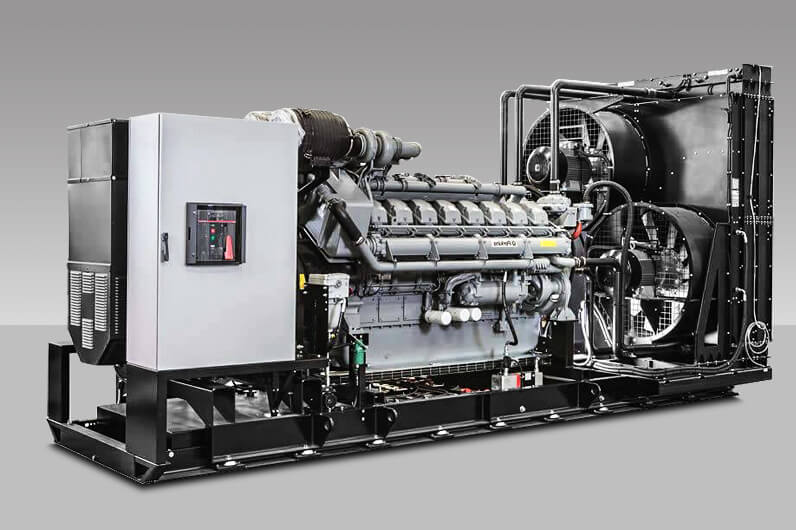
The published series offers the set as an open skid for plant rooms or with a canopy fitted with lockable doors. This is one of the largest visible cost differences between two 150 kVA offers, and it is also a site-planning decision.
An open skid set assumes an indoor or protected location with its own ventilation and exhaust arrangements. A canopy set is a complete outdoor enclosure, and canopy sets are commonly specified in the 65 to 75 dB(A) range at 7 m, a figure that should be confirmed per canopy rather than assumed. The same caution applies across the range: a Perkins 100 kVA generator price quoted on an open skid is not comparable with one quoted in a canopy.
Ask which enclosure is being quoted, whether the doors lock, and what the canopy’s sound level is at 7 m if noise is a constraint for the site.
5. Radiator matched to site ambient
The radiator is rarely mentioned in a headline offer, yet it is one of the items most often “standardised” by the supplier. A radiator sized for a temperate factory floor is not automatically correct for a site with high summer ambient temperatures. If the set is expected to run at full load in a hot climate, the radiator specification must be matched to that ambient, and the quote should say what ambient it was selected for.
This point interacts with the enclosure choice: a canopy restricts airflow compared with an open skid, so the radiator and the canopy have to be considered together. A buyer comparing an open-skid quote against a canopy quote should expect the cooling package to differ, and should not read the difference as pure margin.
6. Packing and protection
The series is packed in a strong wooden case with waterproof cloth. That is a legitimate line item, and it should appear as one. Two offers can both say “export packing” while one uses a lighter case or omits the waterproof layer.
Ask what the case is made of, whether the set is wrapped in waterproof cloth inside it, and whether the packing is included in the quoted total or added later. For a 150 kVA set, packing affects both protection in transit and the shipping volume you will be charged for.
7. A side-by-side comparison table
Use this table to lay two or three offers next to each other before any commercial discussion. The right-hand column is the reference from the published series; the middle columns are for the suppliers you are comparing.
| Item to itemise | Supplier A | Supplier B | Reference (published series) |
|---|---|---|---|
| Engine designation | 1106A-70TAG2 on WP-P120GF | ||
| Engine rating and speed | 1500 rpm at 50 Hz; 1800 rpm on request at 60 Hz | ||
| Alternator make and frame | Brushless, single-bearing, self-excited; make and frame stated in quotation | ||
| Voltage and phase | 400/230 V, 3-phase, 4-wire; 440 V to order | ||
| Power factor | 0.8 lagging | ||
| Panel functions | Manual start, or automatic start with ATS interface and dry contacts | ||
| Enclosure | Open skid, or canopy with lockable doors; canopy commonly 65–75 dB(A) at 7 m, confirm per canopy | ||
| Radiator ambient rating | Selected to match site ambient | ||
| Fuel tank | Integral base-frame fuel tank | ||
| Packing | Strong wooden case with waterproof cloth |
If a supplier cannot fill a row, that row is an open question, not a missing detail. The quote is not yet comparable until it is answered in writing.
What the 150 kVA class sits inside
It helps to see the 150 kVA offer in the context of the series, because buyers often move between classes as load calculations firm up. The published 50 Hz models include:
- WP-P24GF — 24 kW / 30 kVA, 1103A-33G
- WP-P50GF — 50 kW / 62.5 kVA, 1104A-44TG1
- WP-P80GF — 80 kW / 100 kVA, 1104C-44TAG2
- WP-P110GF — 110 kW / 137.5 kVA, 1106A-70TG1
- WP-P120GF — 120 kW / 150 kVA, 1106A-70TAG2
The engine designation changes at the 100 kVA step and again at the 137.5 kVA step. A buyer who initially asks for a Perkins generator 30kVA price and later revises the requirement upward should expect the engine platform, alternator frame and enclosure dimensions to change with it, not just the figure on the quotation.
Typical duty across the series is commercial and industrial standby, hotels and clinics, pumping, and workshop or factory power. The duty cycle you describe determines which panel and enclosure choices are sensible, and it should be stated in the enquiry so the supplier can quote the right configuration rather than a generic one.
What is not in this article
No prices appear here, and that is deliberate. A meaningful figure depends on the configuration you select across the six points above, and on commercial terms that are specific to each order. The manufacturer, Jiangsu Qingzhiteng Power Equipment Co., Ltd. in Yangzhou, exports to more than 80 countries; the configuration that suits your site is the starting point for a quotation.
To get a comparable offer, send the required output, voltage and frequency, the intended duty, the site ambient temperature, whether the set will be indoors or outdoors, and the panel mode you need. Request a quotation that itemises each row of the table above.
FAQ
Why do two 150 kVA Perkins generator quotes differ so much?
Because “150 kVA” is one output point, while the set is built from an engine, alternator, panel, enclosure, radiator and packing. Each can be specified differently. Ask for the engine designation, alternator make and frame, panel functions, enclosure type, radiator ambient rating and packing to be listed, then compare row by row.
Is the 150 kVA model the same engine as the 100 kVA model?
No. In the published series, the 100 kVA model WP-P80GF uses the 1104C-44TAG2, while the 150 kVA model WP-P120GF uses the 1106A-70TAG2. The engine platform changes with the output class.
Can the set be supplied at 60 Hz?
Yes, 60 Hz at 1800 rpm is available on request. The quotation should state the operating speed so the engine rating and alternator are matched to it.
How quiet is the canopy version?
Canopy sets are commonly specified in the 65 to 75 dB(A) range at 7 m. Confirm the figure for the specific canopy quoted, since the enclosure design affects the result.
What fuel tank comes with the set?
The base frame incorporates an integral fuel tank. The capacity and any additional tankage should be stated in the quotation.