Two silent generators quoted at the same kVA can differ by thousands because a silent set is a noise number with a canopy around it. This article breaks the price into the parts buyers can actually compare: the dB(A) level and the distance it is measured at, the canopy that has to achieve it, and the engine, alternator, panel and fuel tank behind it.
Silent Set Buying Guide
Two suppliers quote a 50 kVA silent generator in the same week. One offer is noticeably higher, both say “silent”, and neither datasheet explains the gap. In most cases the difference is not the engine size. It is the noise specification written into the canopy — and the hardware that has to deliver it.
The short answer: a silent generator is a noise number at a distance. Level, distance, ambient conditions and measurement position decide how much canopy the set needs. Engine platform, alternator, control panel and fuel tank then decide where the rest of the price sits. Compare those four items and the quotes start to line up.
Start with the number, not the word “silent”
There is no single industry threshold that makes a set silent. Sound-attenuated sets from the 7.5 kVA class up to 1000 kVA and above are commonly specified between 65 and 75 dB(A) at 7 m, depending on the build. That is a range, not a guarantee, and the level your site needs has to be confirmed against the build you are offered.
A 50 kVA set quoted at the quiet end of that range and one quoted at the upper end are different products. The gap is not marketing language — it is extra lining, tighter door sealing, a different exhaust arrangement and a more constrained cooling path. All of that is material and labour, and it shows up in the price.
Why the measurement distance changes the comparison
Generator sound figures are usually quoted at 7 m rather than at 1 m. A set described at 1 m reads much louder than the same set described at 7 m, even though nothing about the machine has changed. When two offers sit side by side and one number looks dramatically better, check the distance before reading anything into it.
| What to compare | Why it matters to the price |
|---|---|
| dB(A) level and the distance it is measured at | A lower level at the same distance needs a heavier attenuation package. A level quoted at a shorter distance is not comparable. |
| Measurement position around the set | Front, side, exhaust end and above the canopy do not read the same. An offer should say where the figure applies. |
| Ambient conditions at your site | A boundary next to a residence is judged differently from an industrial yard. The target level is a site decision before it is a product decision. |
| Canopy construction | Lining, door sealing and exhaust routing are the three items that actually produce the attenuation. |
If a quote gives a dB(A) figure with no distance and no position, it cannot be checked against another supplier. Ask for the measurement basis in writing before you weigh the two prices.
How the canopy turns a number into a price
Attenuation is a combination of three things: absorbent lining inside the canopy, sealing around the doors and panels, and the arrangement of the exhaust. On a small set, the exhaust is often the dominant path — the sound leaves through the exhaust much more readily than through the canopy walls, so exhaust routing and silencing carry a large share of the result.
The second constraint is cooling. Every layer of lining and every sealed joint reduces the air path through the enclosure. A build aiming at the quieter end of the range has to route intake and outlet air carefully so the set still cools under load. That design work and the extra sheet-metal shaping are part of what you are paying for.
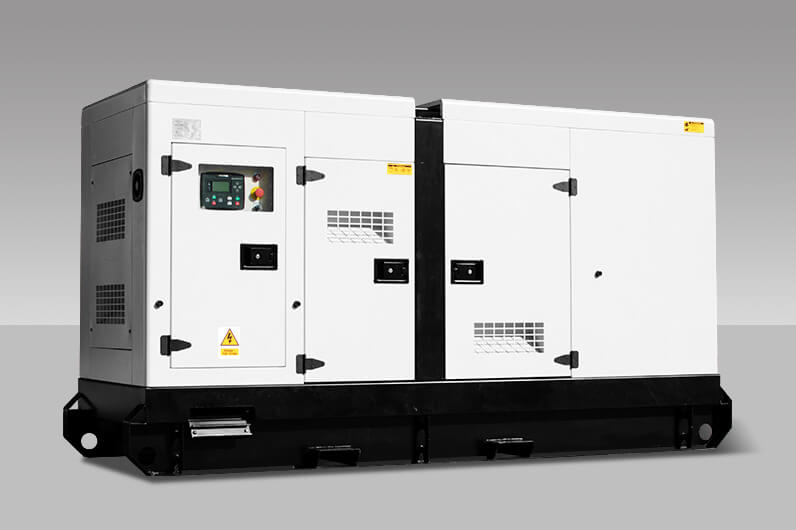
Typical sound-attenuated construction includes a painted steel canopy with absorbent lining, lockable doors and lifting points, with a base-frame integral tank inside the canopy. The tank position matters for two reasons: it keeps the fuel inside the footprint of the set, and it removes an external tank connection that would otherwise be another path for sound and another item to specify.
The 32 amp question: what connection actually comes with a 50 kVA set
Buyers searching for a 32 amp silent generator are usually working backwards from a connection they already have — a socket, an inlet or a distribution board rated at 32 A. A set in the 50 kVA class produces far more current than a single 32 A outlet can carry, so the two requirements point at different ends of the range.
That does not make the search wrong. It means the 32 A figure is a distribution detail, not a set rating, and it should be raised with the supplier alongside the kVA requirement. The practical questions are what output voltage and phase arrangement you need — these sets are commonly 400/230 V three-phase, with 440 V to order — and how the set connects to your existing panel. Automatic start with an ATS interface is available where the set has to pick up a load without an operator, and a manual start version suits sites where starting is a deliberate action.
Where the rest of the price sits
Engine platform
Within the 30–75 kVA band, the engine platform is the single largest line in the quote. As a reference point, the SDEC 50 Hz range includes the WP-S50GF at 50 kW / 62.5 kVA on the SC4H95D2, and the WP-S75GF at 75 kW / 93.75 kVA on the SC4H115D2. A 50 kVA requirement sits between these two reference models, which is exactly where buyers find offers that look similar on paper but are built on different displacement and cylinder configurations. The SDEC series pages list the reference models so you can match the engine to the duty you actually have.
Alternator
The alternator is the second component that moves the price. It has to match the engine output and the load profile — a set that will run a clinic or hotel at steady load is specified differently from one that will carry a motor-heavy commercial standby load. Ask which alternator is quoted and confirm it is sized for the set rather than borrowed from a smaller frame.
Control panel
Panel choice is a real cost line and an operational one. A panel that can be read with the doors closed keeps the operator outside the canopy, which is the point of a silent set in a residential or urban boundary location. Automatic start with an ATS interface adds components and wiring that a manual start set does not carry.
Fuel tank
With the tank integrated into the base frame inside the canopy, tank capacity is part of the enclosure design rather than an add-on. Larger capacity means a taller base frame and more steel. It also sets how long the set can run between refuels — a figure worth stating explicitly for a standby installation at a hotel or clinic that may run for extended hours during an outage.
Matching the build to the site
The same 50 kVA set is specified differently depending on where it stands. Typical duty for sound-attenuated sets includes hotels and clinics, residential and urban boundaries, mobile and marine installations, and commercial standby.
- Residential or urban boundary: the noise target drives the quote. Confirm the dB(A) level, the distance and the measurement position, and check the exhaust path against the nearest boundary.
- Hotel or clinic standby: panel readability with doors closed and automatic start matter as much as the noise figure. Ask how the set interfaces with the existing distribution board.
- Mobile or marine installation: lifting points and the integral tank inside the canopy become handling questions, not just acoustic ones.
- Commercial standby: duty cycle and load profile decide the alternator and tank size, which is where two otherwise similar offers diverge.
A comparison checklist for two quotes
Put the two offers side by side and fill in the same fields for each. Where a field is blank, that is the question to send back.
- dB(A) level, the distance it is measured at, and the position around the set
- The noise level your site actually requires, and who confirmed it
- Engine model and rated output in kW and kVA
- Alternator make and sizing
- Panel type, readability with doors closed, manual or automatic start, ATS interface
- Fuel tank capacity and whether it is integral to the base frame
- Output voltage and phase — 400/230 V three-phase as standard, 440 V to order
- Canopy construction: lining, door sealing, exhaust arrangement, lifting points
The sets are manufactured by Jiangsu Qingzhiteng Power Equipment Co., Ltd in Yangzhou, and exported to more than 80 countries. Packaging is a strong wooden case with waterproof cloth, which matters for a canopy set because the enclosure is a painted steel surface that should arrive unmarked. Full construction details are listed on the silent type generator page.
Frequently asked questions
Is 65–75 dB(A) at 7 m loud enough to be a problem?
That depends on the site, not the number alone. A residential boundary and an industrial yard are judged against different expectations. The useful step is to establish the level your location requires, then ask which build meets it — the range quoted for sound-attenuated sets is a starting point for that conversation.
Why is one 50 kVA silent set cheaper than another at the same kVA?
Usually because the noise specification, the canopy construction, the engine platform, the alternator, the panel or the tank capacity differ. The kVA rating only fixes the output class; it does not fix any of those six items.
Can I compare a figure quoted at 1 m with one quoted at 7 m?
No. The distance has to match before the numbers mean anything to each other. Most generator sound figures are quoted at 7 m for this reason.
Does a quieter set cost more to run?
The acoustic package itself is a construction cost, not a running cost. Cooling air path design is the part that interacts with operation — a build aimed at a lower noise level has to be engineered so the set still cools under load, which is why the canopy design and the cooling path are developed together.
Can the set be supplied at 440 V?
Yes, 440 V is available to order. Standard output is 400/230 V three-phase.
The fastest way to close the gap between two quotes is to send the noise requirement and the site conditions with the enquiry: the dB(A) level you need, the distance it applies at, where the set will stand, and whether you need manual or automatic start. With those four points fixed, the canopy, engine, alternator, panel and tank can be quoted as one defined build instead of two numbers that happen to share a kVA rating.