In the 350–800 kVA class, the duty rating (standby vs. continuous) and site conditions move the price more than the kVA figure itself. This guide explains how engine platform and enclosure choices affect the 450 kVA generator price, with reference models from Mitsubishi and SDEC and practical steps to compare quotes on one enquiry basis.
Generator specification guide
Why the 450 kVA generator price depends on duty, not just kVA
If you are sourcing a generator in the 350–800 kVA range for a plant, mine, water station or mini-grid, the 450 kVA generator price is often the first figure you compare. But in this class, the kVA rating is only the starting point. Two quotes for a “450 kVA” set can differ significantly because one is built for standby duty and the other for continuous operation. Site conditions — ambient temperature, altitude, room ventilation — and the enclosure type also move the price. The practical way to compare offers is to put every supplier on the same enquiry basis: state your duty rating, site conditions, fuel autonomy and enclosure needs up front.
Key takeaway: the duty rating (standby vs. continuous) and site conditions usually drive cost more than a modest step up in kVA. Specify these before comparing prices.
What “450 kVA” can mean across models
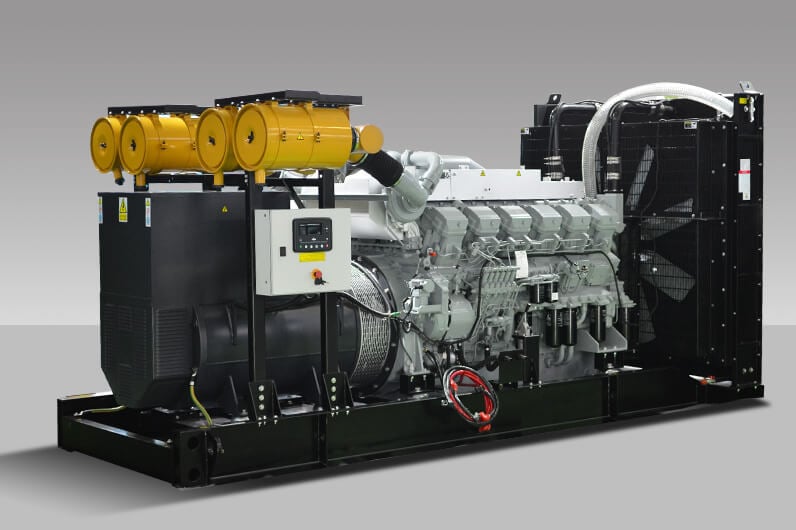
Generators are often referred to by their kVA rating, but the same kVA figure can come from different engine platforms with different power ratings. For example, Mitsubishi-powered models in the 200–1000 kVA range include the WP-SL480GF at 480 kW / 600 kVA (S6R-PTA), the WP-SL520GF at 520 kW / 650 kVA (S6R2-PTA), the WP-SL600GF at 600 kW / 750 kVA (S6R2-PTAA or S12A2-PTA), and the WP-SL800GF at 800 kW / 1000 kVA (S12H-PTA). These are continuous industrial duty sets.
In the SDEC 50 Hz range, reference models include the WP-S350GF at 350 kW / 437.5 kVA (SC15G500D2), the WP-S450GF at 450 kW / 562.5 kVA (SC25G690D2), the WP-S500GF at 500 kW / 625 kVA (SC27G755D2), and the WP-S660GF at 660 kW / 825 kVA (SC33W990D2). Note that a “450 kVA” requirement may fall between these models, so the actual engine selected will depend on the duty rating and site conditions.
When buyers ask for a 450 kVA generator price, they are often comparing sets that are close in kVA but different in engine platform. The engine variant changes with duty rating: a standby-rated set and a continuous-rated set may use different engine configurations even if the kVA is similar.
Duty rating: standby vs. continuous
The duty rating is the single most important factor in the 450 kVA generator price. A standby generator is designed for emergency use and runs limited hours. A continuous generator is designed for prime power and runs for extended periods. The engine variant is confirmed at the order stage because it changes the engine build.
For continuous duty, the cooling system must be matched to the site ambient temperature and the room air path. Fuel autonomy also matters: a base tank suits short autonomy, while continuous running typically requires a day tank and fuel transfer system. If the site needs uninterrupted power, parallel synchronising is available so a second machine can keep production running through maintenance.
Before you compare prices, decide:
- Will the generator run as standby (emergency) or continuous (prime)?
- What is the maximum ambient temperature at the site?
- How many hours per day and days per week will it run?
- Is fuel delivered daily, or is a day tank needed?
- Is parallel operation with another set required for redundancy?
Site conditions and enclosure options
Site conditions affect the cooling package and therefore the price. For a generator room, the air path must be adequate for the engine’s heat rejection at the site ambient. In a containerised build, the enclosure is designed with site-matched cooling. Containerised generators are available from 60 kVA to 1000 kVA, with lockable external service access for maintenance. This is relevant for mines, water stations and mini-grids where the set may be installed outdoors or in a remote location.
If you need a containerised set, specify the ambient temperature and altitude so the cooling system can be matched. The enclosure also affects the price, so be clear about whether you need a standard open set or a containerised version. For more details on containerised options, see the container type generator page.
Electrical parameters are typically 50 Hz at 1500 rpm or 60 Hz at 1800 rpm, 400/230 V three-phase (440 V to order), with a power factor of 0.8 lagging. These are standard for this class, but confirm the voltage and frequency for your site.
Comparing engine platforms: Mitsubishi vs. SDEC
Two common engine platforms in this range are Mitsubishi and SDEC. The Mitsubishi series covers 200 kVA to 1000 kVA for continuous industrial duty, with models such as the WP-SL480GF (600 kVA) and WP-SL800GF (1000 kVA). The SDEC series offers models like the WP-S450GF (562.5 kVA) and WP-S660GF (825 kVA). The choice between them depends on your duty requirements, fuel availability, service network and budget. Both platforms are available in 50 Hz and 60 Hz versions.
When comparing prices, ask for the engine model and whether it is rated for standby or continuous duty. A lower price may reflect a standby-only engine or a smaller cooling package. For more on Mitsubishi-powered sets, see the Mitsubishi series page.
Putting together a single enquiry basis
To get comparable 450 kVA generator prices, prepare an enquiry that includes:
- Required duty: standby or continuous.
- Site ambient temperature and altitude.
- Fuel autonomy: hours of operation without refuelling.
- Enclosure: open set or containerised, with required access.
- Voltage and frequency: 400/230 V or 440 V, 50 Hz or 60 Hz.
- Parallel operation requirement, if any.
With these details, suppliers can quote on the same basis. The manufacturer, Jiangsu Qingzhiteng Power Equipment Co., Ltd, based in Yangzhou, exports to more than 80 countries. Sets are typically shipped in strong wooden cases with waterproof cloth.
FAQ
Does a higher kVA always mean a higher price?
Not necessarily. A continuous-duty 450 kVA set may cost more than a standby-rated 500 kVA set because of the engine variant and cooling package. Always compare on duty rating and site conditions.
Can I use a standby generator for continuous duty?
No. Standby and continuous ratings use different engine variants. Specify the correct duty at the order stage.
What information do I need to get an accurate price?
Provide duty rating, ambient temperature, altitude, fuel autonomy, enclosure type, voltage, frequency and any parallel operation requirement.
Are containerised generators available in this range?
Yes, containerised builds are available from 60 kVA to 1000 kVA with lockable external service access and site-matched cooling.