
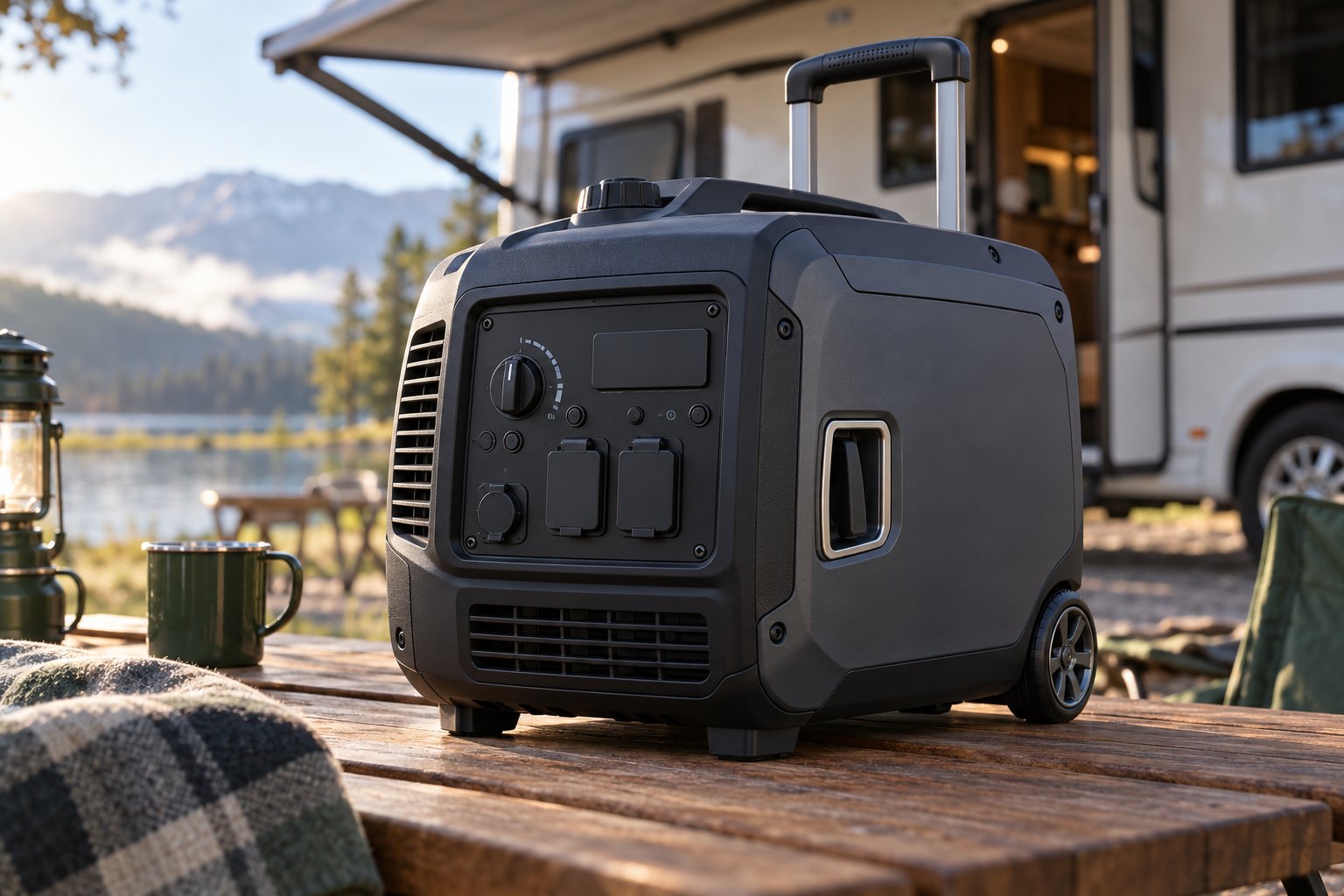
A model-specific buyer's read on the Cummins Onan P4500i inverter generator: official specs, what the inverter design means for sensitive electronics, honest limits of a 120 V portable, and a pre-purchase checklist. Compiled from Cummins' published materials for shortlisting buyers — confirm the current official spec sheet before ordering.
Model deep-dive · Portable inverter
Specifications in this article are drawn from Cummins' own published materials for the Cummins Onan P4500i inverter generator. Jiangsu Qingzhiteng Power Equipment Co., Ltd does not sell Onan portables. Cummins' official documents are the authoritative source; confirm the current official spec sheet and your local dealer before ordering, because published values and product variants can change.
Quick answer: The Cummins Onan P4500i is a gasoline digital inverter portable with a 224 cc OHV engine, 4,500 peak watts and 3,700 running watts at 120 V / 60 Hz single phase. It has a 3.4 gal fuel tank, a 30 A TT-30R RV outlet plus 20 A outlets and two USB ports, parallel capability with another P4500i, and less than 3% THD. It weighs 98 lb with a telescopic handle and wheels, starts by electric, remote or recoil, and is CARB-certified for North America. A dual-fuel variant, the P4500iDF, is also published. Runtime depends on load and fuel; check the current official spec sheet for figures.
What the P4500i is — and what it is not
The P4500i sits in the portable inverter class. It is not a standby generator and not a prime power source for a building or a jobsite with continuous large loads. Its design assumes you move it to the load: a telescopic handle and wheels, a 98 lb frame, and a 3.4 gal gasoline tank. That mobility is the point of the model, and it also defines the limits discussed below.
If you are comparing product families rather than one model, start with the class-level view in Cummins Onan 4500 Watt Generator: Specs and Real Limits — what the 4500-watt class covers, where it stops, and when a buyer steps up to a fixed set. This article stays on the single P4500i so buyers who have already shortlisted it can check the details that matter.
Verified spec table (official Cummins figures)
The table below lists only figures confirmed by Cummins' published materials for the P4500i. Where official documents do not agree — runtime is the notable case — this article does not pick a number.
| Specification | Published value |
|---|---|
| Model | Cummins Onan P4500i inverter generator |
| Type | Gasoline digital inverter portable |
| Peak power | 4,500 W |
| Running power | 3,700 W |
| Voltage / frequency / phase | 120 V, 60 Hz, single phase |
| Engine | 224 cc OHV, 7.3 HP |
| Fuel tank | 3.4 gal (gasoline) |
| Weight | 98 lb, with telescopic handle and wheels |
| Noise | As low as 52 dBA |
| Outlets | 30 A TT-30R RV-ready outlet; 20 A outlets; two 5 V USB ports |
| Parallel capability | Yes — parallel with another P4500i |
| Total harmonic distortion | Less than 3% THD |
| Starting | Electric, remote, recoil |
| Certification / market | CARB-certified; North America availability |
| Dual-fuel variant | P4500iDF — 4,500 W peak / 3,700 W running on gasoline; 4,050 W peak / 3,330 W running on propane |
| Runtime | Depends on load and fuel — see current official spec sheet |
Runtime note: Official Cummins documents have shown different runtime figures at 25% load (15.6 h in one, 18 h in another). Rather than quote one, treat runtime as load-dependent: the heavier the load and the higher the ambient temperature, the shorter the run. Confirm the current official figure for the exact configuration you plan to buy.
What the inverter design means for sensitive electronics
The P4500i uses inverter electronics to produce a cleaner AC waveform than a conventional synchronous generator. Cummins publishes THD below 3% for this model, which is the number that matters if you plan to run laptops, TVs, routers, or similar electronics directly from the generator. It is also the figure that makes the model relevant for RV use alongside the 30 A TT-30R outlet.
Two practical consequences follow from the inverter design:
- Power quality stays stable as load changes. Inverter units decouple engine speed from output frequency, so the AC output does not have to track engine RPM the way a conventional set does. That is the mechanism behind the low-THD claim, and it is why inverter portables are usually the safer choice for electronics than open-frame conventional models.
- Parallel capability doubles capacity with a second unit. The P4500i is published as parallel-capable with another P4500i. That means two units and the correct parallel kit can serve loads beyond a single unit's 3,700 running watts. The kit is a separate item — see the checklist below.
THD rating describes the output quality under the manufacturer's published test conditions. It does not certify that every connected device will be compatible. For any equipment with its own input requirements — medical devices, variable-speed drives, some battery chargers — check the device manual against the generator's published output before relying on it.
Honest limits of a portable-class machine
Buyers who shortlist the P4500i usually want one of three things: RV power, occasional home backup for a few circuits, or remote jobsite power for tools and electronics. The model's published limits are worth stating plainly:
- Gasoline fuel, with a 3.4 gal tank. The standard P4500i runs on gasoline. The dual-fuel variant P4500iDF adds propane, but propane running power is lower (3,330 W running / 4,050 W peak) than gasoline. Fuel choice changes both output and runtime.
- 120 V single phase only. This is a North American residential and light-commercial voltage. It cannot feed 240 V loads such as a typical well pump, electric range, or central air conditioner. If your load list includes 240 V equipment, the P4500i is not the right class.
- Portable-class duty. 3,700 running watts is the continuous design point. It supports a defined set of tools and appliances, not whole-building service. Loads with high starting surges — compressors, pumps, large motors — need to be sized against both running and peak figures, not just the running watts.
- Noise as low as 52 dBA. Published low-noise figures apply under specified conditions, typically lighter load. At higher load the engine works harder and sound levels rise. Treat 52 dBA as the low end of the model's range, not a constant.
- CARB-certified for North America. Emissions certification and availability are market-specific. Whether a given unit is legal and supported where you operate is a question for the local dealer, not something the model name alone settles.
Pre-purchase checklist before you order
Confirm before ordering
- Exact model and variant. P4500i and P4500iDF are different machines with different fuel systems and different output figures on propane. Match the variant to your fuel plan.
- Current official spec sheet. Published specs, especially runtime, can be revised. Ask the seller for the current Cummins spec sheet matching the unit they will ship.
- CARB vs. local emissions rules. CARB certification covers the North American market. If you are buying for use elsewhere, confirm what certification your destination requires.
- Dealer and service support. Confirm who provides warranty service in your region and what parts are stocked locally.
- Parallel kit if you need more capacity. The parallel capability is published, but the kit is a separate purchase. Confirm it is included or available before you plan around two units.
- Outlet compatibility with your load. Match your RV, tools, or transfer setup to the 30 A TT-30R and 20 A outlets. The TT-30R is an RV-standard connector, not a household 30 A dryer plug.
When to move up to an industrial genset instead
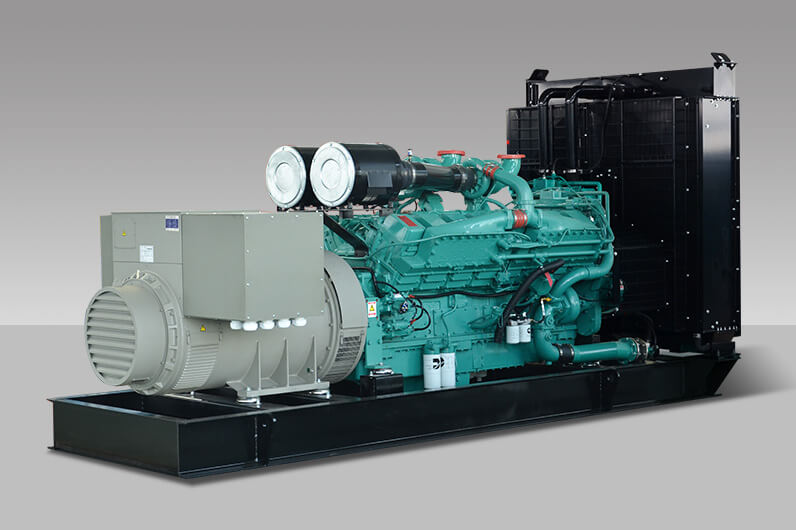
The P4500i stops being the right answer when the load is fixed, three-phase, above 240 V, or continuous. Fixed site loads — a workshop, a small plant, a telecom cabinet, a marine installation — need a different class of machine with different ratings, cooling, and service assumptions. Jiangsu Qingzhiteng Power Equipment Co., Ltd builds Cummins-powered industrial gensets for those applications, which is a separate product family from Onan portables.
If that is your situation, see our Cummins industrial generator range. For noise-sensitive sites such as hospitals or residential-adjacent installations, a silent-type generator is worth comparing. And if the application is onboard — vessel power or auxiliary — the Cummins marine series is the relevant family.
FAQ
Is the P4500i a Cummins Onan generator?
Yes. The P4500i is a Cummins Onan branded portable inverter generator, and the specifications in this article come from Cummins' published materials. Jiangsu Qingzhiteng Power Equipment Co., Ltd does not sell Onan portables; we build Cummins-powered industrial gensets, which are a different product class.
Can the P4500i run sensitive electronics like a laptop or TV?
Cummins publishes less than 3% THD for the model, which is the inverter-class figure relevant to electronics. Check the input requirements of the specific devices you plan to run, especially anything with a motor or a medical function.
How long will it run on a full tank?
Runtime depends on load and fuel, and official documents have shown conflicting figures at 25% load. Confirm the current official runtime for your configuration rather than planning around a single number.
What is the difference between the P4500i and the P4500iDF?
The P4500iDF is the dual-fuel variant. On gasoline it is published at 4,500 W peak / 3,700 W running; on propane at 4,050 W peak / 3,330 W running. The standard P4500i is a gasoline unit. If you need propane, confirm the variant explicitly at order.
Can I use the P4500i for a 240 V appliance?
No. The model's published output is 120 V, 60 Hz, single phase. Appliances that require 240 V are outside this unit's capability and belong in a different generator class.