
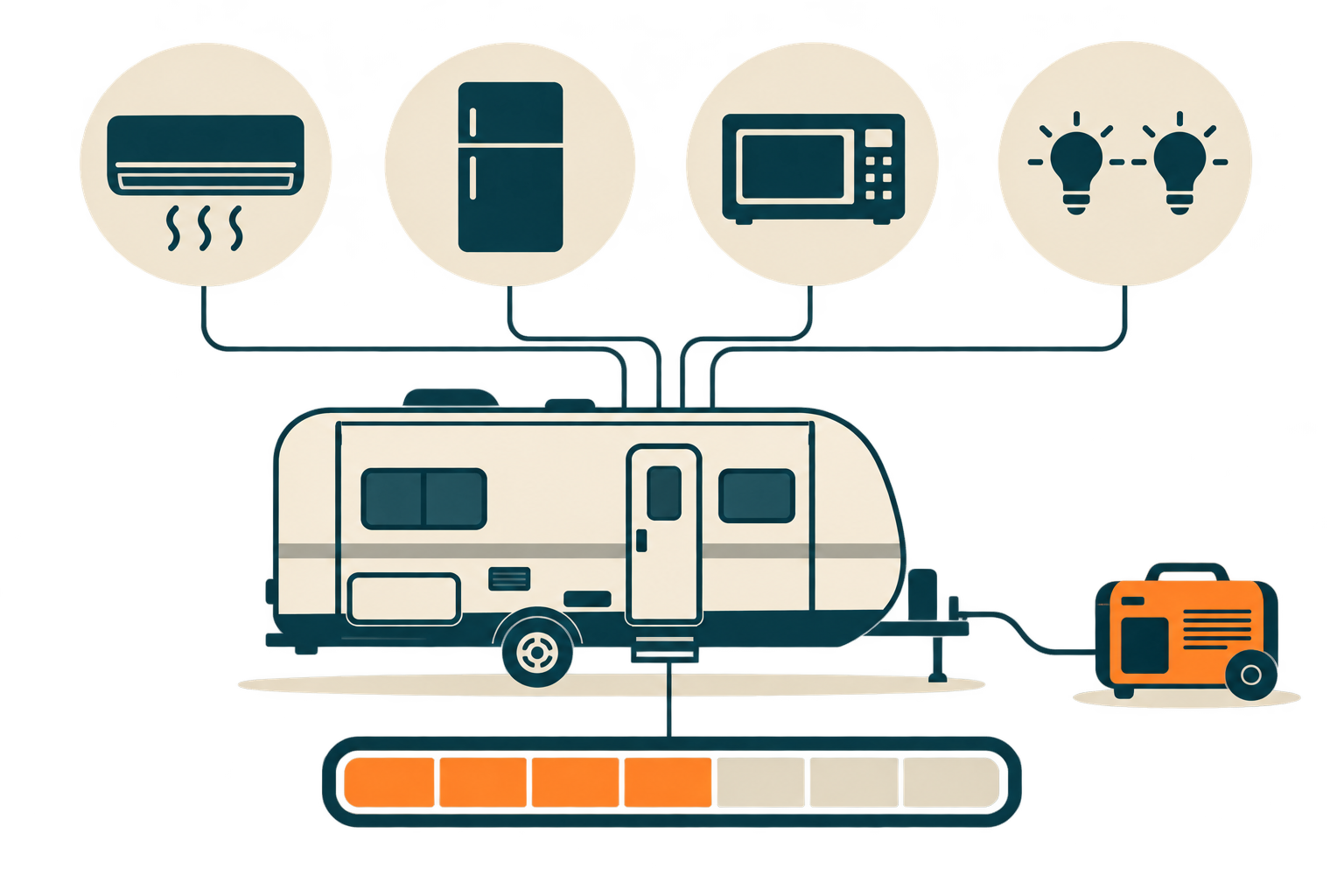
A repeatable, load-based way to size an RV generator: list the loads you run at once, read running and starting watts off the nameplate, total them, add headroom, then check the outlet and service limits before comparing candidate models. Includes a worked symbolic example, the 120 V 30 A service ceiling, noise claims in dBA, and a pre-buy checklist.
RV Power Sizing Guide
If you search for what size RV generator do I need, most results hand you a wattage chart that assumes appliances you do not own. The number you actually need comes from your own nameplates: list the loads you run at the same time, add their running watts, account for the largest starting surge, then check whether your RV's inlet and wiring can carry that total. This page walks through that method step by step, then shows how to shortlist a best RV generator or quietest RV generator without relying on marketing labels.
Key takeaways
- Size to the loads you operate simultaneously, not the total of everything installed in the RV.
- Running watts and starting watts are different numbers; inductive loads can draw a multiple of running watts for a moment at startup.
- A 120 V 30 A RV inlet tops out around 3,600 watts. A larger generator does not push more through that connection.
- Use a specific model's official running and peak ratings as the final check, not the headline wattage alone.
- "Quiet" claims mean little without a dBA figure and a stated distance; enclosure design and mounting matter as much as the number.
On this page
- The five-step sizing method
- A worked symbolic example
- Starting watts vs running watts
- Noise claims, dBA, and campground rules
- When a 4,500-watt-class portable is enough
- Pre-buy checklist and FAQ
The five-step sizing method
Work through these five steps in order. Each one can change the answer, so resist picking a generator first and justifying it afterward.
Step 1: List the loads you run at the same time
Write down only what you would switch on together during your typical worst case, for example a summer afternoon or a cold morning. A practical grouping looks like this:
- Continuous comfort loads: air conditioner compressor, refrigerator, freezer, lighting.
- Short-cycle loads: microwave, coffee maker, induction or resistive cooktop, hair dryer.
- Occasional loads: water pump, laptop and device chargers, television, satellite or Wi-Fi hardware.
- Charging loads: converter or inverter-charger, house battery charger.
If you would never run a coffee maker and a hair dryer at the same moment, do not add them together. Sizing for imaginary simultaneity is the single most common reason people buy more generator than they need.
Step 2: Read running and starting watts off each nameplate
Every appliance carries a rating plate or manual page. Copy two numbers for each item: running watts (sometimes printed as input power or rated input) and, where stated, locked-rotor or starting watts. Motors and compressors are the ones that matter here. If the plate lists amps instead of watts, multiply amps by the operating voltage, and remember that a rating plate is a nominal value, not a measurement of your unit.
Step 3: Total the running watts
Add the running watts of everything on your simultaneous list. This total is your steady-state demand and the floor for continuous generator output.
Step 4: Identify the largest starting surge, then add headroom
You do not add every starting surge together. You add the steady total plus the single largest starting surge among the loads likely to start while others are already running. Then add headroom for voltage sag, cold ambient temperatures, and loads that draw slightly more than their label suggests. Many buyers use a margin in the range of 20 to 30 percent on top of steady demand; treat that as a working assumption to be checked against the candidate model's official ratings.
Step 5: Check the outlet and service limits
This step eliminates generators that look sufficient on paper. An RV power inlet rated 120 V 30 A, fed by a TT-30R connection, is a 30 A 120 V circuit. At that voltage it tops out near 3,600 watts. A 7,000-watt generator connected through a 30 A inlet still delivers roughly 3,600 watts to the RV; the extra capacity is unusable unless you also change the inlet, cord, and distribution. Fifty-amp RVs use a different inlet and distribution arrangement, and that is a separate calculation.
Also confirm the generator's own outlet configuration. A TT-30R outlet is a 30 A 120 V connection, so a generator that offers one can feed a 30 A RV inlet through the matching cord. A generator with only household-style outlets needs an adapter, and adapters do not raise the circuit's ampacity.
A worked symbolic example
The numbers below are placeholders. Substitute your own nameplate values; the point is the arithmetic, not these particular figures.
| Load (example) | Running watts | Starting watts | Runs simultaneously? |
|---|---|---|---|
| Example Load One — air conditioner compressor | Running value from nameplate | Starting value from nameplate | Yes |
| Example Load Two — refrigerator | Running value from nameplate | Starting value from nameplate | Yes |
| Example Load Three — lighting and chargers | Running value from nameplate | Starting value from nameplate | Yes |
| Example Load Four — microwave or coffee maker | Running value from nameplate | Usually none stated | Only one at a time |
Sum the running watts of the loads you marked yes. Suppose that steady total is Example Total Running Watts. Suppose the largest starting surge belongs to Example Load One and equals Example Largest Starting Watts. Your peak requirement is Example Total Running Watts plus Example Largest Starting Watts. Then apply your headroom margin, and compare the result against the candidate model's published running and peak ratings.
As a concrete reference point for the comparison step, the Cummins Onan P4500i portable inverter is rated by Cummins official materials at 3,700 running watts and 4,500 peak watts. That gives a wide steady-state ceiling but a defined surge ceiling, which is exactly the pair of numbers you need to test against your own totals. It is one reference point among several, not a recommendation, and it does not tell you whether your inlet can carry the output.
Starting watts vs running watts: the trap that distorts every estimate
Running watts describe steady operation. Starting watts describe the brief inrush when a motor or compressor spins up. Two mistakes follow from confusing them.
- Adding all surges at once. This inflates the requirement and pushes buyers toward oversized portables they then run at low load, which is inefficient and louder than necessary.
- Ignoring surge entirely. The generator may start and run the air conditioner on a mild day, then trip its breaker on the first hot afternoon, or when the refrigerator compressor happens to cycle while the air conditioner is starting.
A third trap sits in surge ratings themselves: two manufacturers can label peak wattage under different conditions and for different durations. Compare peak figures only when you know how each is defined, and prefer the model's official documentation over marketplace listings.
Noise claims, dBA, and campground rules
Quietest RV generator searches usually return relative claims rather than numbers. Two specifications make comparison possible. The first is sound pressure in dBA at a stated distance, for example at 23 feet or at 7 meters. Without a distance, the figure cannot be compared to another model. The second is enclosure design: a closed, lined enclosure with engineered airflow paths and vibration isolation behaves differently from an open-frame unit, and mounting on a rubber-isolated platform reduces structure-borne noise transferred into the RV.
Campground rules matter as much as the dBA number. Many parks set daytime and nighttime limits and restrict generator hours outright. A unit that measures well at 23 feet can still exceed a park's limit when it sits close to a neighboring site. If quiet operation is your priority, ask the supplier for the sound rating and its reference distance, then compare it to the rules at the parks you actually use.
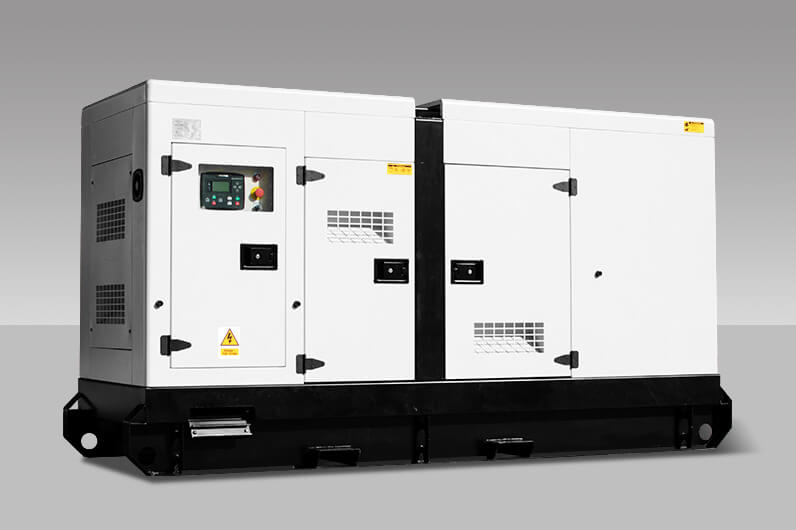
For fixed sites and park-level installations, a sound-attenuated diesel set is the conventional choice. Jiangsu Qingzhiteng Power Equipment Co., Ltd supplies fixed and park-level backup equipment such as Cummins-powered generator sets, and the silent type generator for sites where noise limits are enforced. Marine and mobile installations use a separate product family, the Cummins marine series. One caution: Onan portables are not part of this company's product range; the P4500i figures above are cited only as a public reference point from Cummins materials.
When a 4,500-watt-class portable is enough, and when to step up
Portable inverter generators in the 4,500-peak-watt class are common for travel trailers, fifth wheels, and smaller motorhomes running one air conditioner, a refrigerator, lights, and electronics. Their appeal is inverter output for sensitive electronics, manageable weight, and lower noise at partial load.
- Likely sufficient: one air conditioner, normal house loads, no simultaneous high-draw appliances, and a 120 V 30 A inlet.
- Consider stepping up: two air conditioners running at once, an electric cooktop plus other loads, or a residential-style refrigerator cycling during air conditioner startup.
- Different solution entirely: extended boondocking at high altitude or in high heat, where output derating reduces available watts and a larger, quieter installed set may serve better.
Altitude and heat affect output qualitatively: air is thinner or hotter, combustion and cooling degrade, and available power falls below the sea-level rating. Rather than estimating a percentage, use the manufacturer's derating guidance for the candidate model and check it against your summer conditions.
Pre-buy checklist
- Simultaneous load list written down, with nameplate running and starting watts.
- Steady total plus largest starting surge, with your chosen headroom margin.
- RV inlet type confirmed: 120 V 30 A, TT-30R-compatible, or 50 A.
- Circuit ampacity compared against the calculated peak, not against the generator's headline rating.
- Candidate model's official running and peak ratings checked, including derating notes for altitude and temperature.
- Sound rating obtained as dBA at a stated distance, then compared to campground rules.
- Outlet configuration and included cords verified against your inlet.
FAQ
Can I run my RV air conditioner on a 4,500-peak-watt portable?
Usually, if the air conditioner starts alone or with only light loads already running. Check the nameplate starting watts, and allow for the refrigerator compressor cycling at the same time. If the breaker trips on hot days, surge headroom is the likely cause.
Why does a bigger generator not give me more power in my RV?
Because the inlet and distribution wiring cap what reaches the appliances. A 120 V 30 A connection is limited to 30 amps at 120 volts, so excess generator capacity has nowhere to go unless the inlet and service are upgraded.
Are inverter generators quieter than conventional ones?
Inverter units often run at variable engine speed, which reduces noise at partial load, but the enclosure and mounting determine the measured dBA. Ask for the rating and its reference distance rather than relying on a category label.
Should I add up the starting watts of every appliance?
No. Use your steady total plus the single largest starting surge among loads that may start while others are running. Adding all surges produces an inflated requirement.
Do I need a diesel set instead of a portable?
Portables suit travel use. Fixed and park-level sites with enforced noise limits are usually served by sound-attenuated diesel sets sized by the same load method but installed differently. Confirm the applicable sound and electrical requirements for your site before specifying.
If you are specifying a fixed or park-level set, describe the simultaneous loads, the inlet or service arrangement, the site's noise limits, and the ambient conditions. Those four inputs let a supplier size the set instead of guessing.