By Mr. Xiao | Senior Power Solutions Expert
Updated for 2026 | Global Power, Trusted Style
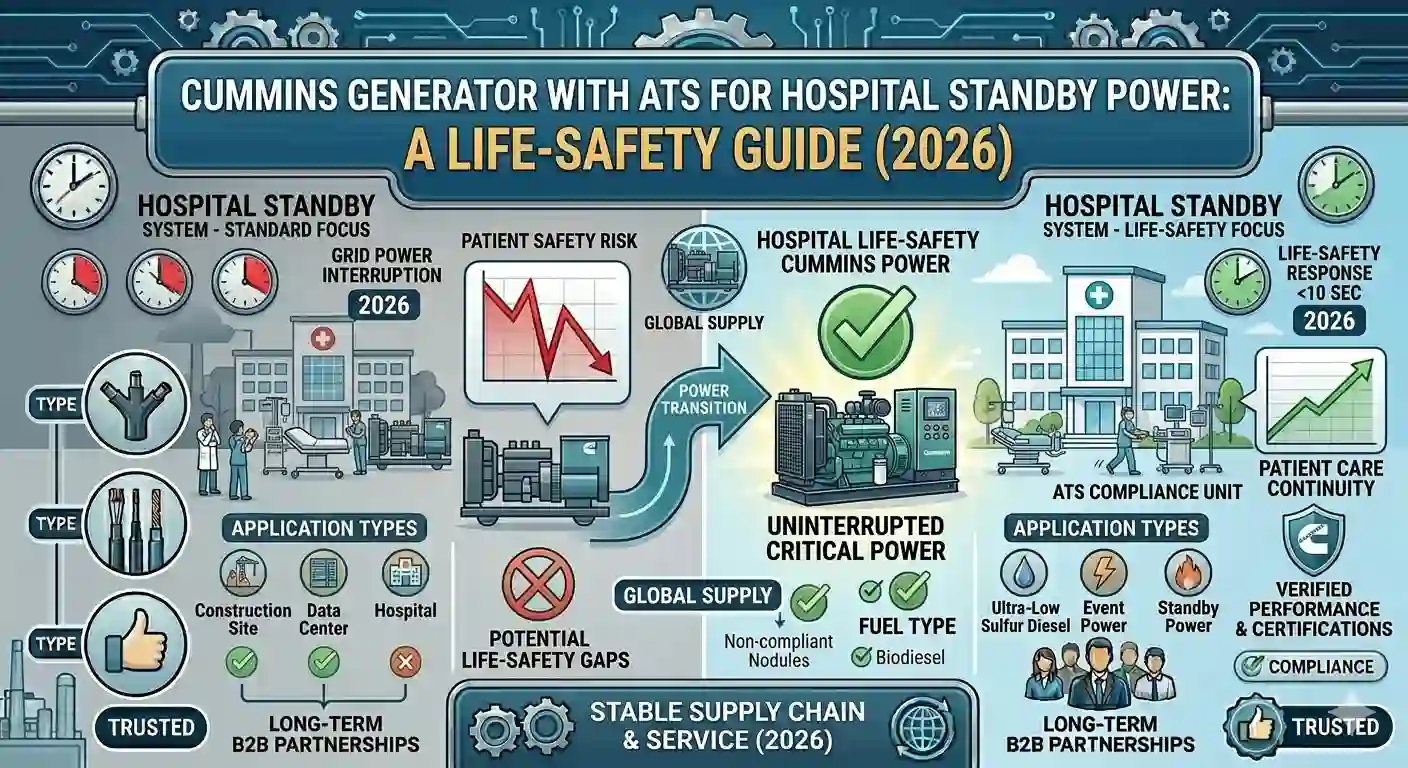
Picture this. It is 11:40 PM in a regional hospital in Riyadh. A surgical team is forty minutes into a cardiac bypass procedure. Outside, a severe sandstorm has knocked out the city grid. The lights flicker. Then everything goes dark.
In that moment, it does not matter how skilled the surgeon is, how advanced the monitoring equipment is, or how well-trained the nursing staff are. If the hospital's backup power system does not restore electricity within seconds, the outcome is catastrophic. There is no second chance. There is no workaround.
This is not a hypothetical scenario. Across the Middle East and sub-Saharan Africa in 2026, extreme weather events — from intensifying sandstorms in the Gulf to grid-destabilizing floods in Nigeria and Kenya — are causing grid failures at a frequency that no healthcare facility can afford to ignore. For hospital facility managers and medical engineering contractors, the question is not whether to install a Cummins generator with ATS. The question is whether the system you are about to install will actually perform when a human life depends on it.
In this guide, I want to explain exactly how a Cummins diesel generator paired with a properly configured Automatic Transfer Switch (ATS) works, why the switching speed matters more than almost any other specification in a medical context, and what to verify before you sign a procurement contract.
Why Hospital Power Failure Is a Different Category of Emergency
Every facility hates a power failure. A factory loses production. A data center risks data corruption. A retail store loses sales. These are serious, but they are recoverable.
A hospital is different because some of what it does cannot pause — not even for ten seconds. Consider the equipment categories that require absolutely uninterrupted power in a functioning hospital:
Operating theaters: Surgical lighting, electrosurgical units, anesthesia machines, and patient monitoring systems must not drop power mid-procedure under any circumstances.
Intensive care units (ICU): Ventilators, infusion pumps, and cardiac monitors are keeping patients alive on a moment-by-moment basis.
Neonatal units: Incubators regulating premature infant body temperature cannot tolerate even a brief thermal interruption.
Diagnostic imaging: MRI machines and CT scanners contain sensitive superconducting components that can be damaged — and require lengthy recalibration — after an unexpected power loss.
Blood banks and pharmaceutical cold storage: Vaccines, blood products, and temperature-sensitive medications must remain within narrow temperature ranges around the clock.
This is why healthcare power systems are not simply "backup generators." They are life-safety infrastructure. And they need to be specified, procured, and installed with an entirely different level of scrutiny than industrial or commercial power backup.
What Is an Automatic Transfer Switch and How Does It Actually Work?
An Automatic Transfer Switch (ATS) is the intelligent electrical component that sits between the utility grid, your standby generator, and your facility's internal electrical distribution system. Its single purpose is to detect a grid failure and seamlessly redirect your facility's power supply from the dead utility feed to the live generator output — automatically, without any human intervention, at any time of day or night.
Here is the sequence of events in a properly engineered system during a grid outage:
Grid failure detection: The ATS continuously monitors incoming utility voltage and frequency. The moment readings fall outside acceptable parameters — typically within 0.5 to 1.5 seconds of the failure — the ATS registers an outage event.
Generator start signal: The ATS immediately sends an automatic start command to the Cummins diesel generator. Modern Cummins engines are engineered for fast-start capability, reaching full operational speed and stable output voltage within 10 to 15 seconds under normal ambient conditions.
Transfer execution: Once the ATS confirms that the generator output is stable — correct voltage, correct frequency, correct phase — it executes the transfer. Power is switched from the utility feed to the generator output. For a properly configured hospital ATS cabinet, this transfer takes less than one cycle of the electrical waveform.
Utility restoration and retransfer: When the grid returns and has been stable for a configured dwell period (typically 5 to 15 minutes, to avoid transferring back onto an unstable grid), the ATS automatically transfers the load back to utility power and initiates a cool-down shutdown of the generator.
For a well-configured system, a facility manager or nursing staff member may never even know the transfer happened. The lights may flicker briefly, or not at all.
The Critical Variable: Switching Speed and Why Seconds Kill
When evaluating any hospital standby power system, switching speed is the specification that separates a life-safety system from a liability. Let me be direct about the numbers.
| Power Interruption Duration | Impact on Standard Hospital Equipment | Risk Level |
|---|---|---|
| Under 0.5 seconds | UPS-backed systems bridge the gap. No noticeable interruption to most equipment. | ✅ Acceptable (Life-Safety Standard) |
| 0.5 to 10 seconds | Computers reboot. Some monitors reset. Non-UPS-backed infusion pumps alarm. Surgical lighting may briefly fail. | ⚠️ Moderate Risk (Tolerable Only for Non-Critical Areas) |
| 10 to 30 seconds | Ventilators lose power. Surgical monitoring systems go offline. MRI field instability. ICU equipment alarms cascade. | ❌ High Risk — Potential Clinical Consequences |
| Over 30 seconds | Full loss of life-critical systems. Battery backup on ventilators depletes. Incubator temperatures drift. Blood product degradation begins. | ❌❌ Critical — Irreversible Clinical and Safety Consequences |
This table makes one thing absolutely clear: for operating theaters, ICUs, and neonatal units, the ATS switching speed must fall firmly into that first row. Everything else is a compromise that a healthcare facility cannot ethically accept.
The Cummins + Qingteng ATS System: Engineering for Zero-Tolerance Environments
At Qingteng, we do not sell generators and ATS cabinets as separate catalogue items that a contractor assembles on site. We engineer them as an integrated system, factory-tested together, so that the communication protocol between the ATS controller and the Cummins engine's AMF (Automatic Mains Failure) module is optimized before the unit leaves our facility.
Here is what our Cummins + ATS configuration delivers specifically for medical facility applications:
Automatic Mains Failure (AMF) Detection: The ATS continuously polls grid voltage and frequency. Detection of a fault condition triggers the generator start sequence with zero manual intervention required — 24 hours a day, 365 days a year, including at 3 AM during a sandstorm when no facility engineer is on site.
Stable Output Before Transfer: Our ATS controller verifies that the Cummins generator has reached correct voltage (within ±2%) and frequency (within ±0.5Hz) before executing the transfer. This prevents sensitive medical equipment from receiving out-of-tolerance power during the changeover.
Priority Load Management: Our ATS cabinets can be configured with tiered load prioritization. Critical circuits — operating theaters, ICU, emergency lighting — receive power first and are protected from being shed if the generator is operating near capacity.
Remote Monitoring Interface: Our control system supports remote status monitoring, allowing your facility engineering team to verify generator readiness, fuel level, and maintenance status from a central management point — without physically entering the generator room.
Parallel System Ready: For larger hospitals requiring N+1 redundancy — where a second generator provides failover if the primary unit develops a fault — our system supports full parallel configuration and synchronization.
For hospitals requiring large-capacity solutions above 1000kVA, we recommend reviewing our 1000kVA Cummins industrial generator specifications and our high-capacity containerized Cummins generator sets for project and tender use , both of which are available with fully integrated ATS cabinet configurations.
Middle East & Africa Specific Considerations: Heat, Dust, and Humidity
Specifying a Cummins generator with ATS for a hospital in Frankfurt is a reasonably straightforward engineering exercise. Specifying the same system for a hospital in Khartoum, Lagos, Riyadh, or Nairobi introduces a set of environmental variables that directly affect system reliability — and therefore patient safety.
These are the factors our engineering team accounts for in every Middle East and Africa hospital project:
Ambient temperature derating: Diesel engines and alternators lose output capacity as ambient temperature rises. A generator rated at 500kW at 25°C may produce only 460kW to 480kW at sustained 45°C ambient temperatures common in Gulf states during summer. We factor this into sizing calculations at the quotation stage — not after installation.
Dust and particulate ingress: Fine particulate matter from desert environments accelerates engine filter clogging and causes premature wear on alternator windings if not properly managed. Our enclosures for Middle East deployments use enhanced IP-rated air filtration and extended service interval filter specifications.
Coastal humidity and salt air: For hospitals in coastal African cities — Lagos, Mombasa, Dar es Salaam, Dakar — salt-laden humid air accelerates corrosion of electrical contacts, control panels, and structural components. We apply corrosion-resistant coatings and specify marine-grade hardware for these environments on request.
Fuel quality variability: In many African markets, diesel fuel quality and sulfur content varies significantly between suppliers and regions. Cummins engines are engineered to tolerate a broad range of fuel quality, but we always recommend fuel polishing systems and primary fuel filtration for critical medical applications.
Procurement Checklist for Medical Facility Managers
Whether you are a hospital facility director evaluating your first generator system or a medical engineering contractor preparing a tender specification, these are the non-negotiable items your generator and ATS supplier must be able to confirm before contract signature.
☑ CE certification covering Machinery Directive 2006/42/EC — for EU-exported or EU-standard-compliant projects.
☑ ISO 8528 compliance with verifiable load bank test reports from the factory.
☑ AMF/ATS system integrated and factory-tested as a matched unit — not field-assembled from separate suppliers.
☑ Ambient temperature derating calculation provided for your specific installation site conditions.
☑ Priority load configuration available for critical versus non-critical circuit separation.
☑ After-sales support commitment — ideally 24/7 multilingual technical assistance and sub-4-hour response for medical facilities.
☑ Spare parts availability confirmed for your region, particularly for Cummins engine consumables and ATS control modules.
☑ Delivery timeline confirmed in writing — for critical healthcare infrastructure, 7 to 15 days factory dispatch is the benchmark.
Frequently Asked Questions (FAQ)
Q: What does ATS actually stand for, and is it different from an AMF panel?
A: ATS stands for Automatic Transfer Switch. AMF stands for Automatic Mains Failure, which refers specifically to the detection and generator-start function. In practice, a complete hospital backup power control panel typically integrates both functions — the AMF module detects the grid failure and starts the generator, while the ATS physically switches the load connection from utility to generator. At Qingteng, we supply integrated AMF/ATS control cabinets as a single engineered unit.
Q: How large a Cummins generator does a medium-sized hospital in Nigeria or Saudi Arabia typically require?
A: This depends heavily on the hospital's total connected load, the proportion of critical versus non-critical circuits, and ambient temperature derating at the installation site. For a 200-bed regional hospital, a 500kVA to 1000kVA generator is a common starting range, but accurate sizing requires a detailed load analysis. Our engineering team provides this analysis as part of the pre-sales consultation at no charge.
Q: Can Qingteng supply generators configured for both 50Hz (Middle East/Africa standard) and 60Hz (some African and export markets)?
A: Yes. Our OEM/ODM engineering capability allows us to configure output voltage and frequency to your specific market requirements before shipment — whether that is 380V/50Hz for Saudi Arabia and most of sub-Saharan Africa, 400V/50Hz for East African markets, or other regional standards. Please specify your grid requirements at the inquiry stage.
Q: What after-sales support does Qingteng provide for hospitals in remote locations in Africa?
A: We provide 24/7 multilingual technical assistance via phone, email, and video call, with a committed response time of under 4 hours for critical facility clients. For remote African deployments, we prioritize rapid spare parts dispatch through our global logistics network and can coordinate on-site technical visits where required. We also offer remote generator monitoring system integration for facilities that want real-time status visibility from a central dashboard.
Q: Does extreme heat in the Middle East affect the ATS cabinet electronics, not just the engine?
A: Yes, and this is a frequently overlooked specification point. ATS control electronics have operating temperature ratings, and standard cabinets specified for temperate climates may experience control board failures in sustained 45°C to 50°C ambient environments. For Gulf state deployments, we specify industrial-grade control components rated for high-ambient operation and recommend shaded or climate-controlled generator room placement where feasible. This is a detail we discuss with every Middle East project inquiry.
Your Patients Cannot Wait. Neither Should Your Power System.
Qingteng supplies CE-certified Cummins generators with integrated ATS cabinets, factory-tested for life-safety applications. Engineered for Middle East heat, African dust, and coastal humidity. Dispatched within 7 to 15 days from our 5,000-unit inventory.
About the Author: Mr. Xiao
Chief Technical Writer & Healthcare Power Infrastructure Specialist at Qingteng. Mr. Xiao has advised hospital facility teams and medical engineering contractors across the Middle East and sub-Saharan Africa on life-safety generator specifications, ATS system design, and extreme-climate power infrastructure for over a decade.
References & Technical Standards
ISO 8528-1:2018 — Reciprocating internal combustion engine driven alternating current generating sets: Application, ratings and performance.
EU Machinery Directive 2006/42/EC — Mechanical safety requirements for industrial power generating equipment.
UDEM CE Attestation Certificate — Covering Qingteng Diesel Generator Sets (GDC, GDP, GDYD series), valid through February 19, 2028.
IEC 60364-7-710 — Electrical installations of buildings: Requirements for special installations or locations — Medical locations.
CQC ISO 9001:2015 Quality Management System — China Quality Certification Centre, covering three-phase brushless synchronous generator production.
Shanghai Beichen ISO 14001:2015 — Environmental Management System Certification, valid through April 2027.
