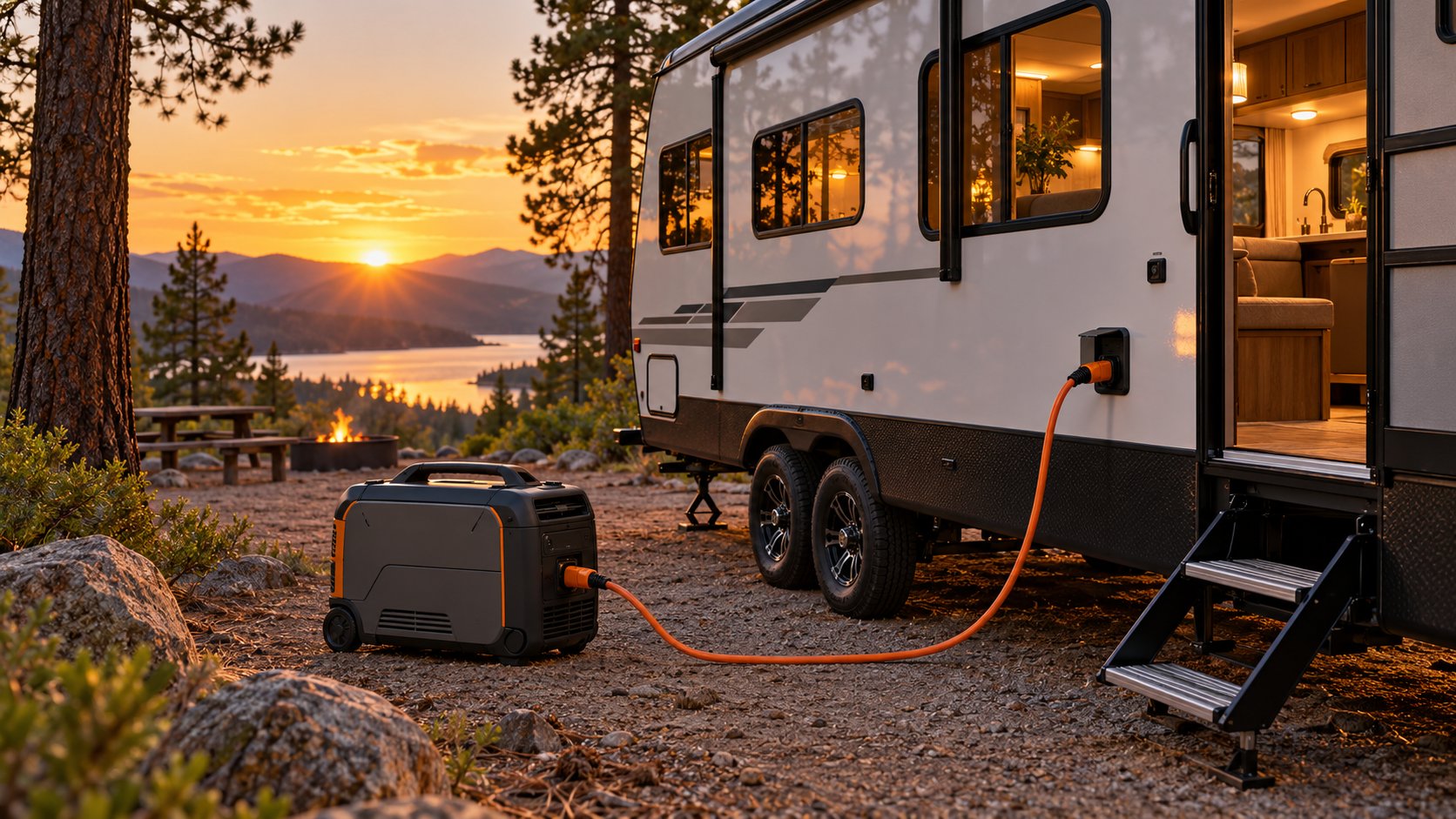
The Cummins Onan 4500-watt class is the P4500i inverter generator: 4500 peak watts, 3700 running watts on gasoline, 120 V, and an RV-ready TT-30R outlet. This explainer covers what that wattage actually carries, where it stops, and when a buyer needs a larger diesel set instead.
Selection Boundary
Short answer: the Cummins Onan 4500-watt class is the P4500i inverter generator — 4500 peak watts, but 3700 running watts on gasoline. That 3700 W figure, not the 4500, is what your loads actually draw against. If everything you need to run at the same time stays under that running figure and starts without a large surge, the 4500-watt class fits. If it does not, no amount of marketing copy changes the number.
Key takeaways
- Peak watts are a brief starting allowance; running watts are the continuous working figure. Size loads against running watts.
- Official P4500i figures: 4500 peak W, 3700 running W gasoline, 120 V / 60 Hz, 224 cc engine, TT-30R 30 A RV outlet, parallel capable with a second P4500, 98 lbs, noise as low as 52 dBA.
- The class suits RV use and light job-site or backup loads one or two at a time — not whole buildings.
- Once loads are large, continuous, or noise-constrained, the answer shifts to a fixed industrial diesel set.
What “4500 watts” actually means
Two ratings sit inside the same headline number, and buyers routinely compare the wrong one.
- Peak (surge) watts cover the split second a motor starts — a fridge compressor, a pump, a power tool. The allowance lasts only as long as the start.
- Running (rated) watts are what the generator holds continuously. On the P4500i that is 3700 W on gasoline.
The practical rule: add up the running watts of everything you intend to run simultaneously and keep the total below the running rating, then check whether the largest motor’s starting surge still fits inside peak. If you size against 4500 W, you will overload the machine on the first hot afternoon.
Model context: what the Onan 4500-watt line is
Onan is Cummins’ brand for portable and RV generators. In the current 4500-watt class the specific product is the P4500i inverter generator. Its published figures are the ones worth quoting, because they are what the spec sheet and the dealer will stand behind.
| Parameter | Value |
|---|---|
| Peak watts | 4500 W |
| Running watts (gasoline) | 3700 W |
| Voltage / frequency | 120 V / 60 Hz |
| Engine displacement | 224 cc |
| RV outlet | TT-30R, 30 A |
| Parallel capability | Yes — with a second P4500 |
| Weight | 98 lbs |
| Noise | As low as 52 dBA |
Two of those rows matter more than the rest for selection. The TT-30R outlet is the RV-standard 30 A connection, which is why this class is bought mainly by RV owners rather than as a general household backup. The parallel capability means two P4500 units can be combined when a single unit’s running watts fall short — a middle option between one portable and a fixed set. The 120 V output is single-phase, which is a hard boundary: 240 V equipment is out of scope for this class entirely.
For a model-specific breakdown of the P4500i — verified specifications, what the inverter design means in practice, and a pre-purchase checklist — see the companion article, Inside the Cummins Onan P4500i Inverter Generator.
Load-fit: what the 4500-watt class carries, and where it stops
Because the running rating is 3700 W, the useful question is not “what can 4500 watts run?” but “which combination of loads stays under 3700 W while running, with surge headroom on top?”
Typical fits
- RV use. A single RV air conditioner plus basic loads — lights, a television, phone chargers, a small fridge — is the design case for the TT-30R outlet. This is the scenario the class was built around.
- Light job-site and event loads. One or two power tools, a small compressor, or a laptop and lighting setup, run one or two at a time rather than all at once.
- Short-duration backup. Keeping a fridge, freezer, and a few small loads alive through an outage — provided you manage what is switched on together.
Where it stops
- Whole-home backup. A 120 V, single-phase unit cannot feed 240 V appliances such as a central air conditioner, electric range, or well pump.
- Simultaneous heavy loads. Multiple large motor loads started at once will exceed both running and surge capacity.
- Continuous duty. Portable inverter units are built for intermittent use, not for running a business or a building around the clock.
- Noise-sensitive or occupied sites. Quieter than a conventional open-frame portable, but 52 dBA at close range is still a portable-generator noise level, not a fixed-installation level.
When the answer is a larger, fixed generator set
The 4500-watt class is deliberately portable. Once the requirement becomes mechanical rather than occasional, the selection logic changes in three ways: capacity, duty, and location.
- Capacity and voltage. Loads that need 240 V, three-phase, or a running total well above the portable rating need a fixed set sized to the actual load list — not a portable multiplied by two.
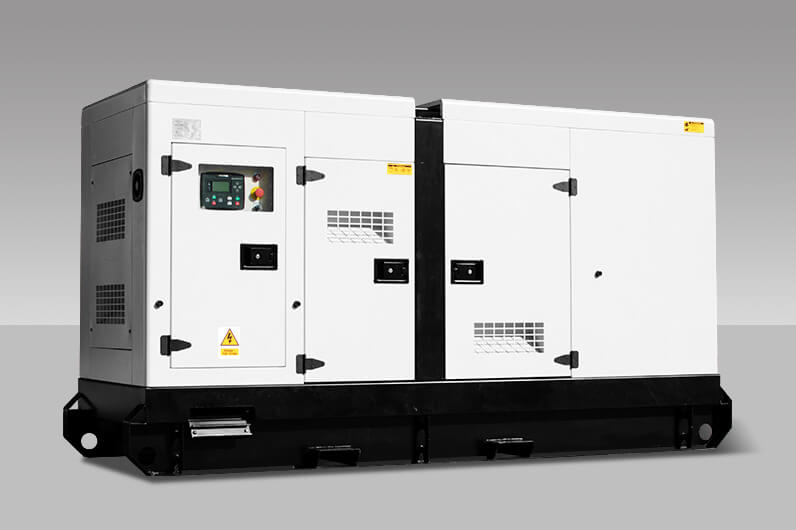
- Duty cycle. Continuous operation, prime power, or standby for a facility calls for an industrial machine with the right alternator and cooling for that duty. Cummins-powered industrial diesel gensets are the category to look at when the load is fixed and continuous rather than occasional.
- Noise and siting. Note that Jiangsu Qingzhiteng Power Equipment Co., Ltd does not sell Onan portable generators, so this section is about the adjacent category a buyer steps into, not a like-for-like product swap.
As a rule of thumb, if a buyer is comparing a portable against a fixed set, they have already left the 4500-watt class behind. The fixed set is specified from the load list and the site, not from a headline wattage.
Noise: the boundary that decides larger sites
At 52 dBA, the P4500i is among the quieter portables. That is still measured close to the machine, and it is still a portable rating. Where neighbours, shift work, or residential proximity set a hard limit, larger sites move up to a sound-attenuated diesel set instead of adding more portables.
Those enclosures are specified for the site’s noise limit, not for a single number on a brochure; the enclosure, the siting, and the load all affect the result. For marine installations the same reasoning applies with different constraints — see Cummins marine series if the load is on a vessel rather than a site.
FAQ
Is a Cummins Onan 4500-watt generator good for an RV air conditioner?
Yes — this is the class’s primary design case. The P4500i has a TT-30R 30 A RV-ready outlet and enough running capacity (3700 W) to carry a single RV air conditioner plus basic loads. The practical limit is simultaneous load: run the air conditioner alongside lights and small electronics, not alongside every high-draw appliance in the coach at once.
How long will an Onan 4500-watt generator run?
Runtime depends on the load and the fuel tank, and published figures for this class vary by source. Rather than quote a misleading number, use the official Cummins spec sheet for the P4500i and read the runtime figure against your own expected load — runtime at half load and at full load are different answers. Size the fuel you carry from your continuous load, not from the headline rating.
Can I run 240 V equipment from it?
No. The P4500i is a 120 V / 60 Hz unit. Appliances that require 240 V are outside the class and require a different generator category.
Can two units be combined for more power?
Yes — the P4500i is parallel capable with a second P4500. This is useful when a single unit’s running capacity is just short, but it does not make the pair equivalent to a fixed industrial set for continuous duty.
The short version: size against 3700 running watts, keep starting surge inside 4500 peak watts, and treat 120 V single-phase as the hard ceiling. If your load list is longer, continuous, or 240 V, you are shopping in the wrong class — and that is a category decision, not a brand one.