
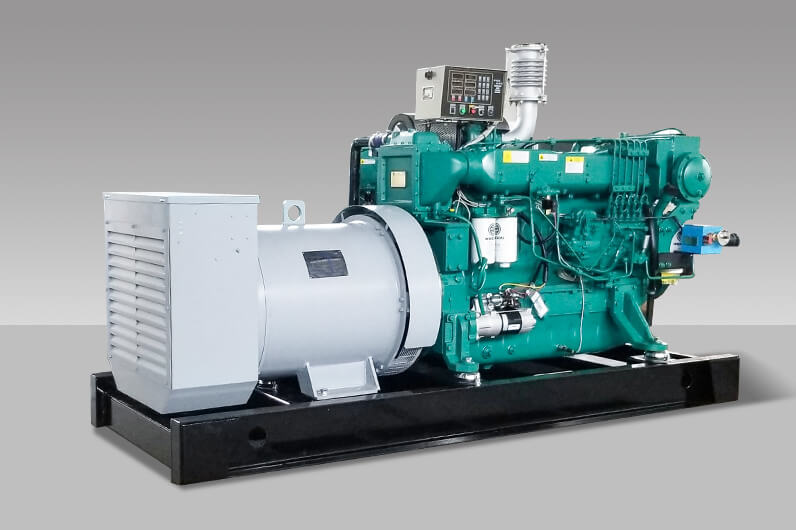
A buyer's method for confirming a Weichai marine genset against the vessel: electrical load first, then engine room space and hatch access, service reach along the operating route, and how cooling and exhaust fit into the layout. Includes the 12–500 kW programme, CCFJ 50 Hz model rows and where the specification stops and the vessel survey begins.
Marine Genset Selection
Most Weichai marine genset enquiries arrive with a power figure already in mind and none of the other answers. The rated output is the easiest part of the specification and rarely the reason an installation goes wrong. What decides whether a set works on a given vessel is the load profile it actually carries, the space and access it must pass through, who can reach it along the route, and whether the cooling water and exhaust can be routed where the set needs them.
This is a working method for confirming a model against a vessel, using the CCFJ series rows that appear on the Weichai marine page. It is not a substitute for a generator vendor's review of your drawings, but it will tell you which questions you can settle yourself and which you should put in the enquiry.
- Step 1: confirm the load, not just the peak
- Step 2: match the load to a published model row
- Step 3: engine room space and hatch access
- Step 4: service reach along the operating route
- Step 5: cooling water and exhaust routing
- Where Weichai and Cummins fit differently
- Questions that come up in selection
Step 1: Confirm the load, not just the peak
Start from a load schedule rather than a nameplate. For each operating condition you actually run — harbour manoeuvring, transit, night at anchor, fish hold refrigeration, deck winch work — list the connected load, what is running simultaneously, and how long that condition lasts. Three things about that schedule decide the genset far more than a single total:
- Base load versus peak. A set sized on a momentary peak runs light for most of its life; a set sized on base load may not carry the peak at all. The schedule has to show both.
- Power factor. The CCFJ series is rated at 0.8 lagging. If your load includes significant motor starting, you need to look at starting duty separately from steady-state kW — motor starting behaviour is a system question, not a single table figure.
- Voltage and frequency. The 50 Hz models run at 1500 rpm; 60 Hz equivalents carry an E2xx suffix and 1800 rpm is available on request. Standard electrical output is 400/230 V three-phase with voltage to order, so confirm this against your distribution board early rather than assuming.
If a single genset cannot cover both base and peak sensibly, that is a decision point, not a failure of the schedule. Some vessels are better served by a smaller set on the base load plus a second unit, or by accepting that the largest consumer is time-managed.
Step 2: Match the load to a published model row
The marine programme runs from 12 kW to 500 kW on Weichai marine diesel engines, with the CCFJ series as the familiar range around the mid-to-upper end. These are the 50 Hz rows as published; the catalogue figures are confirming points, not a selection output on their own.
| Model | Rated output | Weichai engine |
|---|---|---|
| CCFJ24JW | 24 kW | D226B-3CD |
| CCFJ40JW | 40 kW | WP4CD66E200 |
| CCFJ90JW | 90 kW | WP6CD132E200 |
| CCFJ150JW | 150 kW | WP10CD200E200 |
| CCFJ250JW | 250 kW | WP12CD317E200 |
| CCFJ300JW | 300 kW | WP13CD385E200 |
The blank spaces between rows are the point where a specification has to be built rather than picked. Buyers often arrive with an engine size in mind — a Weichai marine engine of roughly 280 hp or 500 hp, for example — because that is the figure carried over from an older installation or from a second-hand engine listing. Neither of those figures maps directly onto a published CCFJ row, and the kW rating of a genset is a set-level output, not an engine output. Bring the load schedule instead: it lets the vendor state which engine and alternator combination meets it, rather than you arriving with an engine code that may not correspond to a catalogue set.
Step 3: Engine room space and hatch access
A genset has to be transported into the vessel, not just to the yard. The unit ships on a base frame with flexible mounts, and it is the base frame — not the bare engine — that sets the footprint and the lifting points you will use.
Before fixing a model, take these measurements and check them against the vessel:
- Hatch opening and the route below it. Width, length and height of the narrowest point between the deck hatch and the final position. An enclosed set that fits the room may not fit the hatch.
- Clearance for the base frame and flexible mounts. Space around the frame for the mounts to sit correctly and for the set to be aligned, not just for the frame to clear the floor.
- Headroom over the set. Needed for lifting gear during installation and for anything that must be opened or removed above the unit in service.
- Air path through the room. A genset in an enclosed space needs combustion air and a path for radiated heat. The room's ventilation arrangement is a vessel-side responsibility, but the set's position in the room determines whether it can work.
If the space is tight, say so in the enquiry and provide the drawing. Layout can be adjusted far more cheaply at quotation than after the set has been landed.
Step 4: Service reach along the operating route
This is where inland and coastal buyers part company from ship operators, and it is worth planning deliberately. A genset is serviced where the vessel operates, not where it was built. For fishing vessels, workboats and tugs, cargo and utility craft, and passenger vessels running fixed routes, the practical question is: how far is the vessel from someone who can work on a Weichai marine engine, and what is on board to make that work possible?
Consumables circulate through the marine supply chain in Asia, Africa and the Middle East, which is relevant when the operating route sits inside those regions. Beyond that, three practical items belong in the selection file:
- Which port or yard the vessel returns to, and how often. A route that touches a main port monthly supports a different maintenance plan from one that stays on a remote coastline for a season.
- The control panel and instrument arrangement. The standard control panel sits at the operating station, with a remote panel available as an option. Confirm where the panel will actually be watched from — the wheelhouse, an engine room station, or both — because that decision shapes the panel specification and the alarm visibility.
- What the crew can safely do themselves. Filters, levels and visual checks belong to the crew; anything requiring the set to be opened up does not. Agreeing that boundary before delivery is more useful than discovering it mid-season.
Step 5: Cooling water and exhaust routing
Cooling and exhaust are agreed with the vessel route, and both are layout decisions as much as specifications.
The CCFJ series uses sea-water cooling with a heat exchanger, so the raw-water circuit has to reach the set from a seacock and return overboard along an acceptable route. Route length, the height of the set relative to the waterline, and where the pipe run passes all affect the installation; these are vessel facts you can document, and the vendor needs them.
Exhaust is a choice between wet and dry arrangements, agreed against the route the exhaust takes through the vessel. Wet exhaust needs a route that can handle the water carried with the gas and the fall of the pipework; dry exhaust changes what has to be insulated and where the outlet terminates. Neither is universally better — the route decides. Bring a sketch of the proposed exhaust run rather than asking for a default.
Where Weichai and Cummins fit differently
Buyers replacing a set often ask whether to stay on the same engine platform or switch. Where the existing installation is a Cummins marine set, the Cummins marine series is the natural comparison. The practical selection criteria do not change between platforms — load schedule, footprint through the hatch, service reach, cooling and exhaust routing — but the model rows, engine codes and mounting details do. If you are replacing on an existing base frame, measure the old frame and mounts and include those dimensions, because a drop-in replacement is a layout question and should be treated as one.
What to put in the enquiry
- Load schedule by operating condition, with simultaneous running loads and duration.
- Required voltage, frequency and phase; 50 or 60 Hz.
- Hatch opening dimensions and the route into the engine room, plus a sketch of the intended position.
- Operating region and the port or yard the vessel returns to.
- Preferred exhaust arrangement and the proposed exhaust route.
- Whether the set replaces an existing unit and, if so, the old base frame dimensions.
Questions that come up in selection
Can I specify a Weichai marine genset by engine horsepower?
Better to specify by electrical load and let the vendor confirm the engine. The published CCFJ rows are set-level kW ratings with a named engine behind each one; an engine figure carried over from elsewhere does not map cleanly onto a catalogue row.
Is the 60 Hz version a different engine?
The 60 Hz equivalents carry an E2xx suffix and run at 1800 rpm, available on request. Voltage is to order, so confirm the full electrical specification against your distribution system rather than assuming it follows from the frequency.
What alternator is fitted?
The series uses a brushless single-bearing alternator, rated at 0.8 power factor lagging.
How is the set delivered?
Units ship in a strong wooden case with waterproof cloth. Crating protects the set in transit; it does not resolve hatch access on board, which you should confirm from the vessel's own dimensions.
The programme covers 12 kW to 500 kW on Weichai marine diesel engines, manufactured by Jiangsu Qingzhiteng Power Equipment Co., Ltd in Yangzhou, Jiangsu. Once you have the load schedule, hatch dimensions and route details, the model confirmation becomes a short exchange rather than a catalogue search.