
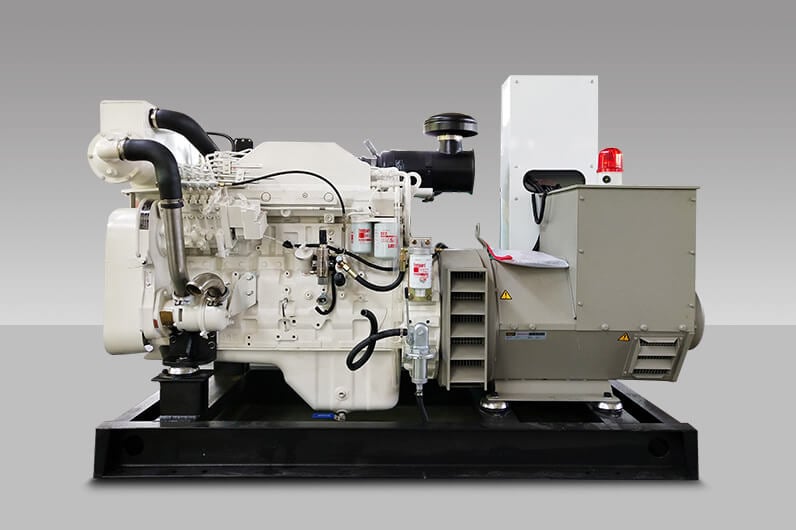
On fishing boats, workboats and small yachts, the compact genset that fails a refit is rarely the one with the wrong kW — it is the one that cannot pass the hatch, cannot reach the sea-water line, or cannot send its exhaust out. This article walks through the physical and electrical checks that decide a small marine diesel generator choice before the nameplate does, with real model data from the Cummins Marine and Weichai Marine programmes (12 kW to 500 kW) and a short honest checklist for owners and yards.
A small marine diesel generator is bought twice: once on paper by kW, and once in the engine room by tape measure. On fishing boats, workboats and small yachts, the second purchase is where most refits go wrong.
The compact set that causes trouble is usually not undersized. It is the one that will not pass a hatch, whose heat exchanger does not line up with the sea-water pipework already in the hull, whose exhaust cannot be routed without cutting a bulkhead, or whose alternator is sized for a peak nobody planned for. For sets in the 12 kW to 50 kW band the physical and circuit questions often decide the choice as much as the load list does.
This article works through those questions in the order a yard actually faces them, using the Cummins Marine and Weichai Marine programmes as concrete examples. Both run from 12 kW to 500 kW, including the 12 kVA class for smaller vessels.
What Decides a Small Genset Fit
- Access path first: hatch opening, turning space and lifting points before any kW discussion.
- Sea-water circuit: a heat exchanger sized to the pipework already in the boat is what makes a replacement a drop-in job.
- Exhaust route: wet or dry, and which one the hull can actually accept.
- Alternator versus continuous hotel load: match the brushless single-bearing alternator to what runs hour after hour, not to the start-up peak.
- Panel at the operating position: readable and reachable from where the crew actually stands.
- Engine protection: flexible mounts and the protection set the set is built with.
Start With the Hatch, Not the Nameplate
Before comparing models, measure the route the set will travel: the dock crane or davit, the deck hatch, the companionway, the engine-room door, and the clear space around the final position. A set on flexible mounts needs clearance on all sides, and the enclosure or base frame adds to the footprint. Write down the smallest opening and the tightest turn; that number eliminates more candidates than any load calculation.
Lifting is the second half of the same question. Confirm where the set can be slung and whether the yard's lifting gear reaches that point with the set hanging. A set that fits the room but cannot be landed in it is not a candidate.
Packing matters here too. Sets ship in a wooden case with waterproof cloth, which protects the unit in transit but adds dimensions at the dock. Ask for the crated dimensions as well as the bare-set dimensions, because the hatch the crate must clear is not always the hatch the set must clear.
The Sea-Water Circuit: Match the Heat Exchanger to the Pipework You Have
On a replacement job, the sea-water circuit is usually the difference between a weekend and a haul-out. These sets are sea-water cooled through a heat exchanger, and the exchanger can be sized to the existing pipework when a set is being replaced. That is a specification item to raise at quotation stage, not something to discover during installation.
Bring the yard three facts: the sea-water inlet and outlet pipe diameters, the raw-water pump arrangement, and where the strainer sits relative to the new set's position. With those, the exchanger and connections can be matched to the hull rather than the hull being modified to the set.
Exhaust: Wet or Dry, and Which the Hull Accepts
Both wet and dry exhaust arrangements are available across these marine programmes. The choice is not a preference; it is a routing decision. A wet system needs a water-injection point, a rise and fall that will not trap water back into the engine, and space for the run. A dry system needs insulation, clearance from combustible structure and a route to atmosphere that the hull can provide.
Sketch the exhaust run on the engine-room drawing before choosing. If the only workable route crosses a tank, a bulkhead or the crew's sleeping space, the candidate set has just failed a physical test, whatever its kW rating.
Alternator Matching: Continuous Hotel Load, Not Peak
The alternator on these sets is a brushless, single-bearing machine matched to continuous hotel loads. That phrasing is the useful part. Hotel load — refrigeration, lighting, electronics, ventilation, pumps — runs for hours. A winch, a bow thruster or a tool draws a short, heavy peak. Sizing for the peak produces an oversized set that runs lightly loaded for most of its life; sizing for the continuous load and managing the peak separately is the usual approach on small vessels.
Build the load list in two columns: continuous and intermittent. Then compare the continuous total against candidate ratings. Electrical output is 400/230 V three-phase as standard, with other voltages to order, so confirm the vessel's distribution before the order rather than after.
Where the Numbers Land: Small Models in the Two Programmes
Both programmes cover 12 kW to 500 kW. The tables below show the smaller 50 Hz models, running at 1500 rpm; 60 Hz versions run at 1800 rpm.
Cummins Marine — small 50 Hz models
| Model | Rating | Engine |
|---|---|---|
| CCFJ30JC | 30 kW | 4BTA3.9-GM47 |
| CCFJ40JC | 40 kW | — |
| CCFJ50JC | 50 kW | 6BT5.9-GM83 |
| CCFJ75JC | 75 kW | — |
| CCFJ100JC | 100 kW | 6CT8.3-GM115 |
| CCFJ120JC | 120 kW | 6CTA8.3-GM155 |
Weichai Marine — small 50 Hz models
| Model | Rating |
|---|---|
| CCFJ24JW | 24 kW |
| CCFJ30JW | 30 kW |
| CCFJ40JW | 40 kW |
| CCFJ50JW | 50 kW |
| CCFJ64JW | 64 kW |
| CCFJ75JW | 75 kW |
| CCFJ90JW | 90 kW |
| CCFJ120JW | 120 kW |
The 24 kW and 30 kW entries are the band most small fishing boats and workboats land in once the continuous hotel load is written down honestly. Details of the full ranges are on the Cummins Marine Series and Weichai Marine pages. Jiangsu Qingzhiteng Power Equipment Co., Ltd in Yangzhou builds and exports these sets, with exports to more than 80 countries.
The Panel and the Operating Position
The control panel is placed at the operating position. On a small vessel that is a practical constraint, not a detail: the crew may be starting the set from a cramped space beside the engine, or from the wheelhouse. Decide where the set will actually be started and monitored, then check that the panel can be read and reached from that spot without climbing over machinery. Panel position is settled at order, so include a sketch of the engine room with the intended operating position marked.
Engine Protection and Mounting
These sets are supplied on flexible mounts, which keeps engine vibration out of the hull structure and is the normal arrangement for a small marine genset. The protection set built into the unit is what the crew relies on when the engine room is unattended; the yard should confirm what is fitted and that the alarms are visible or audible from the operating position.
Circuits, Not Just kW: A Short Honest Checklist
Use this before requesting quotations. Each line is a fact you can measure or read off the boat.
- Smallest hatch or door the set must pass, in mm, measured with a tape — plus the turn radius into the engine room.
- Crated dimensions of each candidate set, asked for separately from bare-set dimensions.
- Lifting point available on deck and the reach of the lifting gear.
- Sea-water inlet and outlet pipe diameters, and the strainer position.
- Exhaust route sketched, with wet or dry decided by what the hull allows.
- Continuous hotel-load total in kW, kept separate from intermittent loads.
- Vessel distribution voltage and frequency — 50 Hz (1500 rpm) or 60 Hz (1800 rpm), 400/230 V three-phase or another voltage to order.
- Intended operating position marked on an engine-room sketch, for panel placement.
- Clearance available around the set on its flexible mounts.
- Engine protection and alarm arrangements confirmed for the model offered.
If a candidate passes the hatch, the pipework and the exhaust route, and its alternator covers the continuous load, the choice is largely made. The remaining question is commercial.
What This Checklist Cannot Tell You
It cannot tell you whether a specific model will fit your engine room — only your measurements against that model's dimensions can. Where a dimension is not on the published data, ask the supplier for it before ordering. For a replacement set, state clearly that the heat exchanger is to be sized to existing pipework, so the offer reflects that rather than a standard configuration.
Next Step
Send the yard's engine-room sketch, the measured hatch and access route, the sea-water pipe diameters, the exhaust preference and the continuous load total in kW. With those five items, a small marine diesel generator quotation can be built around the set that fits rather than the set that looks right on the datasheet.