
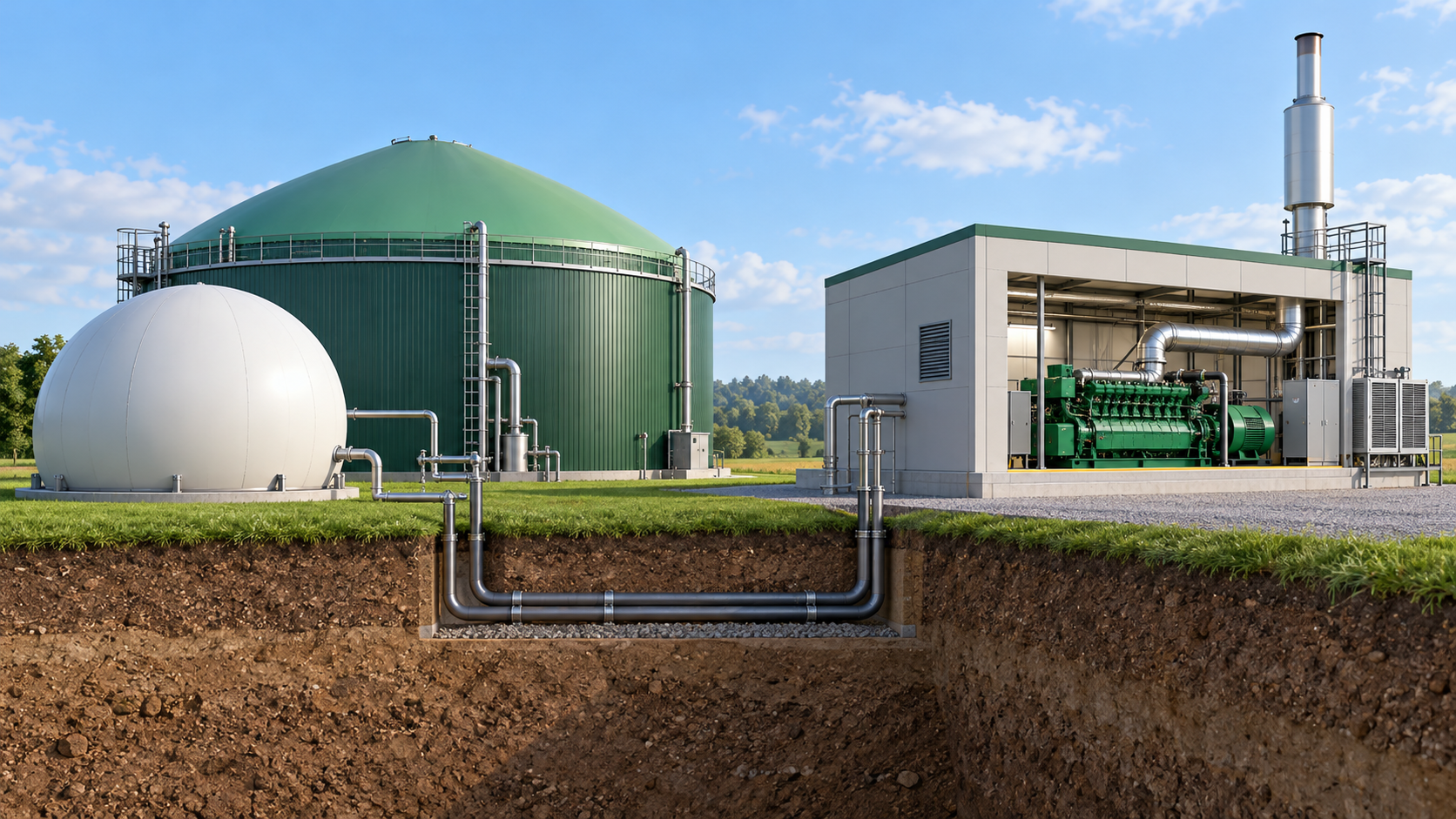
Biogas gensets rarely fail on the engine badge. They fail on gas supply details agreed too late. This pre-order checklist covers what to confirm about methane content, gas conditioning, electrical duty, cooling and service reach before you issue a purchase order — written for farms, wastewater plants and agro-industrial projects comparing offers.
Most biogas genset problems do not start at the engine. They start upstream — at the digester, the gas line and the water that was never quite removed — or downstream, at a switchboard nobody sized against the real site load. When buyers compare biogas generator for sale offers, the engines on the table are usually competent. What differs is how thoroughly the gas supply has been described before the order is signed.
This checklist is for farms, wastewater treatment plants and agro-industrial projects that already have a gas analysis in hand and are now reading quotations. It sets out what to pin down with the supplier before committing, and why each item changes the outcome more than a badge on the alternator.
What this checklist covers
1. Gas quality and methane content from your actual substrate
A biogas engine generator is only as well matched as the gas description it was quoted against. The single most useful thing you can send a supplier is a recent gas analysis tied to the substrate you will actually run, not a typical value copied from a reference project.
Different feedstocks produce different gas. Manure, energy crops, food-processing waste, sewage sludge and landfill gas each shift the methane share, the balance of carbon dioxide, and the presence of hydrogen sulphide, ammonia, water vapour and siloxanes. Even within one site, gas composition can drift with season, feed change or digester performance. Confirm with your supplier:
- Methane content and its range, not a single figure — the engine is quoted for a composition, and a wide spread affects derating and control settings.
- Hydrogen sulphide level, since it drives both the corrosion risk in the gas train and the sizing of desulphurisation.
- Siloxanes if the feedstock includes wastewater sludge or landfill-derived gas; these are handled differently from H₂S.
- Gas pressure available at the engine inlet and how stable it is.
- Moisture and temperature of the gas as delivered to the set.
Suppliers quoting a methane to electricity generator solution should ask you for this data before pricing. If an offer arrives without a question about your gas analysis, treat that as a signal to slow down.
2. Gas treatment and conditioning — who supplies what
Raw digester gas entering an engine carries water vapour, sulphur compounds and sometimes particulates. Conditioning is the boundary between your plant and the genset, and it is where scope gaps are most expensive. Make the split explicit in the offer:
| Item | What to confirm | Why it matters at order stage |
|---|---|---|
| Gas cooling / drying | Whether condensate removal is in the genset scope or plant scope | Liquid carry-over damages the gas train and is not a warranty conversation you want later |
| Desulphurisation | Who sizes it, who supplies media, who replaces it | Determines operating cost and maintenance routine |
| Gas train components | Pressure regulation, filters, flame arrestor, shut-off valves | Clarifies what is mounted on the skid versus the yard |
| Flare / emergency route | How excess or off-spec gas is handled | Affects safety case and operating procedure |
Ask the supplier to draw the battery limit on a simple process sketch. A one-page diagram showing where your gas responsibility ends and theirs begins prevents most commissioning disputes.
3. Site electrical load and duty
Biogas sets are often ordered against a rated output when what the site really needs is a duty point. Write down the electrical situation before you compare offers:
- Continuous base load versus peaking duty. A set running flat-out for most of the year is sized and maintained differently from one covering demand peaks.
- Island or grid-parallel operation. Standalone operation against a site’s own network, or synchronising to a utility, changes the control and protection scope substantially.
- Electrical interface. Whether you need a low-voltage switchgear, transformer coupling, an ATS, or parallel synchronising with existing sets on site.
- Power factor and harmonics. Non-linear site loads affect generator and control selection; tell the supplier what else runs on the same bus.
- Load growth. Whether the site load is expected to change over the next few years, and whether the genset can carry that or needs parallel capacity.
Where the site already runs diesel backup or other generating sets, mention it. Parallel synchronising is a real capability, and it is best designed in at the quotation stage — not added after delivery.
One practical point: write the duty in hours per year and the expected load profile into the specification you send out. Two offers that look the same on a data sheet can be built very differently once duty is stated.
4. Cooling and heat balance
An engine that cannot reject heat cannot deliver its rating. Ask the supplier to confirm the cooling concept against your actual site conditions and, where heat recovery is planned, against the heat user.
- Ambient conditions at the installation: summer peak temperature, altitude, dust, humidity.
- Cooling system type — radiator, remote radiator, or a plant water circuit.
- Heat recovery if the plant intends to use jacket water or exhaust heat for the digester itself. If heat is being recovered, the cooling system must be designed around it from the start.
- Enclosure and ventilation if the set goes into a container or acoustic canopy: air path, intake and discharge, and space around the set.
It is worth confirming how the site will be laid out. A set specified for a ventilated powerhouse may need a different cooling arrangement if it ends up in a container build.
5. Service reach and spares
Service reach deserves the same attention as the engine specification. Ask the supplier:
- Who supports commissioning on site, and what documentation and training come with the set.
- Which consumables and wear parts are expected in the first years of operation, and how they are ordered.
- What remote monitoring is available, and what it lets your team see between visits.
- Typical lead time for critical spares and the route by which they reach your site.
A gas genset is a long-term plant item. A supplier’s ability to respond after delivery is part of the specification, not an after-sales footnote.
6. Commercial terms to confirm in writing
Before issuing a purchase order, check that the quotation states:
- Minimum order quantity and what it refers to — a single set, a scope package, or a spare parts consignment.
- Lead time, including the start date the lead time is measured from.
- Payment terms and currency.
- Scope of supply and exclusions, including gas conditioning, civil works, installation and commissioning.
- Documentation package: drawings, manuals, test records, and any certificates that apply to the delivered set.
If any of these are missing, ask for a written clarification rather than assuming the default. A quotation that states its terms is easier to compare against its competitors, and easier to hold to during execution.
Where the supplier fits in
Jiangsu Qingzhiteng Power Equipment Co., Ltd, based in Yangzhou, Jiangsu, manufactures both diesel and gas generator sets, with an inland range from 3 kVA to 3000 kVA and marine sets from 12 kW to 500 kW, exporting to more than 80 countries across five continents. Sets with ATS, parallel synchronising, low-noise canopies, container builds and remote monitoring are produced in the same works. Enquiries are quoted per configuration, with MOQ, lead time and payment terms stated in the quotation.
For a biogas project the useful next step is to send three things together: your gas analysis, the substrate description, and the electrical load and duty you expect. You can see the full product range for an overview of the configurations offered, or send your gas analysis for a quotation and the team will respond against your actual project data rather than a generic datasheet.
FAQ
- What gas information should I have before requesting a price?
- A recent analysis from your actual substrate covering methane content and its expected range, hydrogen sulphide, moisture, and inlet pressure. If siloxanes may be present, say so.
- Can a gas genset be quoted before my digester is running?
- It can be quoted against the design gas analysis, but the composition should be treated as provisional. Confirm with the supplier how a later change in gas quality is handled.
- Does the genset come with gas conditioning equipment?
- This depends entirely on the scope agreed in the quotation. Ask for the battery limit to be shown explicitly so both sides know what is included.
- Can the set run in parallel with our existing generators or the grid?
- Parallel synchronising capability is offered as part of the configuration. Tell the supplier what the set will parallel with, and at what voltage level, at the enquiry stage.
- What if our site load grows after installation?
- Raise the expected load growth when you request the quotation. It affects sizing and whether parallel capacity should be planned from the start.
The engines on competing offers are rarely the deciding factor. The gas analysis, the conditioning scope, the duty and the service arrangement are what determine whether the set runs reliably in year three. Get those onto paper before you order, and the comparison between offers becomes a factual exercise rather than a guess.