Sizing a three-phase generator by total running load often leads to oversizing or nuisance trips. This article explains why the largest motor's starting current should drive the decision, where 10–22 kVA three-phase sets fit, and when a canopy is worth specifying.
When buyers search for a "10kVA generator 3 phase," they often start by adding up the running watts of everything they plan to connect. That approach can lead to a machine that looks adequate on paper but trips the first time a pump or compressor starts. The reason is simple: motor starting current can be several times the running current, and it is the starting surge—not the steady total—that decides whether the generator holds up.
This article explains how to size a small three-phase set around the largest motor's starting demand, where 10–22 kVA models sit in the lineup, and when a canopy makes sense for noise, weather, and site conditions.
Key takeaways
- Size by starting current, not running total. The largest motor's inrush is the binding constraint for most small three-phase loads.
- 10–22 kVA covers workshops, pumps, telecom cabinets, and site offices with modest motor loads and mixed single/three-phase demand.
- Canopy matters when noise limits, weather exposure, or security are part of the site brief—not just for aesthetics.
- Check the alternator's motor-starting capability and the motor's actual starting method before committing to a kVA rating.
Why running load is the wrong starting point
Three-phase induction motors draw a starting current that is typically several times their full-load current. The exact multiple depends on the motor design and the starting method—direct-on-line (DOL) starting produces the highest surge, while star-delta, soft starters, and variable frequency drives reduce it. For sizing purposes, the key figure is the largest motor's starting current in amps, or its locked-rotor current if the motor nameplate or datasheet provides it.
Small three-phase generators are often chosen for installations where the running load is well below the generator's rating but the starting surge is not. A 10kVA generator 3 phase set, for example, may run a workshop's lighting, hand tools, and a small compressor comfortably—until the compressor's motor tries to start. If the generator's alternator cannot supply the surge, voltage dips, contactors chatter, or the breaker trips.
The practical rule is to identify the largest motor, note its starting current, and compare that to the generator's ability to supply short-duration overload. Manufacturer data for the alternator and the generator's motor-starting capability should be the reference, not a generic multiplier.
Where 10–22 kVA three-phase sets fit
This range covers a broad set of small commercial and agricultural duties. The Yangdong YD-series powered sets from Jiangsu Qingzhiteng Power Equipment Co., Ltd. illustrate the options: the WP-YD9GF (9 kW/11.25 kVA), WP-YD10GF (10 kW/12.5 kVA), WP-YD12GF (12 kW/15 kVA), WP-YD15GF (15 kW/18.75 kVA), and WP-YD20GF (20 kW/25 kVA) sit in and around this band. All are four-cylinder water-cooled engines running at 1500 rpm for 50 Hz, with 400/230 V three-phase four-wire output and a power factor of 0.8 lagging.
| Model | Prime power (kW/kVA) | Engine | Typical fit |
|---|---|---|---|
| WP-YD9GF | 9 kW / 11.25 kVA | YD380D | Small workshop, single pump, site office |
| WP-YD10GF | 10 kW / 12.5 kVA | YD385D | Workshop with mixed tools and lighting |
| WP-YD12GF | 12 kW / 15 kVA | YD480D | Irrigation pump, telecom cabinet backup |
| WP-YD15GF | 15 kW / 18.75 kVA | YND485D | Larger pump set, small site office cluster |
| WP-YD20GF | 20 kW / 25 kVA | YSD490D | Workshop with compressor and welder |
The 10kVA generator 3 phase class—covering models like the WP-YD9GF and WP-YD10GF—is often the entry point for buyers who need three-phase power but have modest running loads. These sets are also available with 230 V single-phase output on smaller ratings, which helps when a site has a mix of single-phase and three-phase equipment.
Buyers comparing a 10 kva 3 phase generator for sale against an 11kva generator price or a 17 kva generator price should look beyond the headline kVA. The starting current capability, alternator type (these sets use a brushless single-bearing self-excited alternator), and control panel options matter more than a small difference in rating.
How to size by starting current: a step-by-step check
Use the following sequence to match a generator to a real load. The numbers here are illustrative; confirm actual values from motor nameplates and generator datasheets.
- List the loads. Separate three-phase and single-phase equipment. Note running watts and, for motors, the starting current or locked-rotor current.
- Identify the largest motor. This is usually the pump, compressor, or conveyor drive that will start under load.
- Check the starting method. DOL starting draws the highest surge. Star-delta, soft start, or a VFD will reduce the surge—confirm what the motor actually uses.
- Compare with generator capability. Ask the supplier for the generator's motor-starting capability and the alternator's short-duration overload rating. A set that can supply the running load plus the largest motor's start is a better fit than one sized only on running total.
- Account for simultaneous starts. If two motors may start together, size for the combined surge or interlock the starting sequence.
For example, a workshop with a 7.5 kW motor started DOL might have a starting current that a 10kVA set cannot supply, even if the running load is only 6 kW. In that case, a 15 kVA or 20 kVA model from the same series—such as the WP-YD15GF or WP-YD20GF—would be the more realistic choice. Conversely, a pump with a soft starter may run comfortably on a 10kVA set.
When a canopy matters
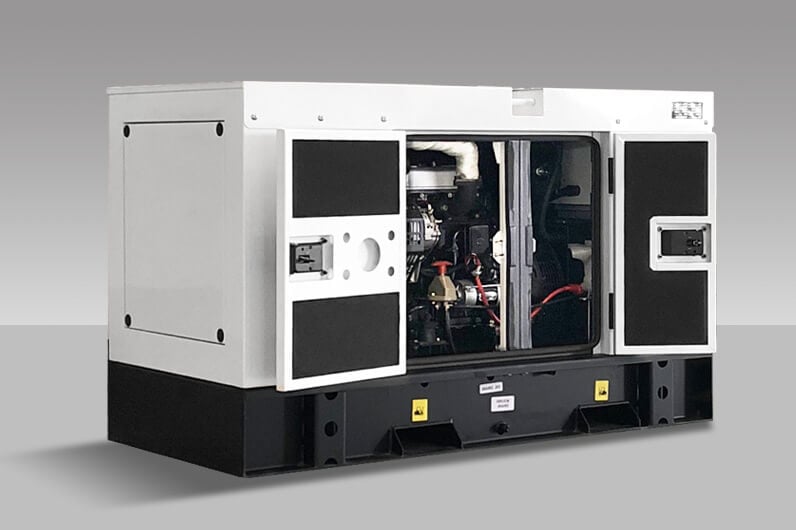
Open skid sets are common for indoor plant rooms or covered installations. But for outdoor sites—construction offices, telecom compounds, irrigation pump houses without a dedicated building—a canopy offers practical benefits. These Yangdong sets are available in open skid or painted steel canopy form, with lockable doors and lifting points. Canopy sets are commonly specified in the 65 to 75 dB(A) range at 7 m, though this should be confirmed per canopy specification.
A canopy is worth considering when:
- Noise limits apply—near residential areas, shared sites, or telecom installations where sound is a concern.
- The set will be exposed to weather and needs protection from rain, dust, and sun.
- Security is a factor—lockable doors deter tampering and theft.
- The site needs a self-contained unit that can be lifted and repositioned.
For buyers searching for a "32 amp silent generator," the canopy option is often part of the brief. A 32 amp three-phase supply corresponds to roughly 22 kVA at 400 V, so a canopy set in the 20–25 kVA range may be relevant. The WP-YD20GF (20 kW/25 kVA) is the closest model in this series; confirm the actual output current and canopy noise level with the supplier.
Canopy selection is not just about noise. It affects access for maintenance, ventilation, and the footprint of the installation. Review the canopy drawing and service access points before specifying.
Control and starting options
These generators are offered with a manual panel with metering or an automatic start panel with ATS interface and dry contacts. For telecom cabinets or site offices where remote start is needed, the automatic option is relevant. For manual start workshops, the manual panel is simpler and adequate. The choice affects wiring and integration with existing switchgear, so confirm the panel configuration early.
All models in the series run at 1500 rpm for 50 Hz; 60 Hz at 1800 rpm is available on request. The base-frame integral fuel tank simplifies installation where a separate fuel supply is not practical.
FAQ
It depends on the motor's starting current and starting method. A 7.5 kW motor started DOL may draw a surge that exceeds the generator's capability. Check the motor's locked-rotor current and the generator's motor-starting rating; a larger model such as the WP-YD15GF may be needed.
Prime power is the continuous rating the generator can supply under varying load. Standby power is a higher, short-duration rating for emergency use. The models listed here are quoted at prime power; confirm the standby rating if the application is backup only.
The output is 400/230 V three-phase four-wire, which provides 230 V single-phase for lighting and small tools. On smaller ratings, a 230 V single-phase configuration is available. Confirm the exact configuration for your model.
Open skid suits indoor or covered installations with good ventilation. Canopy is appropriate for outdoor sites where weather protection, noise reduction, or security is needed. Canopy sets are commonly specified at 65–75 dB(A) at 7 m; confirm the figure for the specific canopy.
Next step
If you are sizing a small three-phase generator, start with the largest motor's starting current, not the running total. The Yangdong YD-series offers models from 9 kW to 60 kW, including the 10kVA and 15kVA classes, with options for canopy and automatic start. For noise-sensitive sites, review the silent canopy range.
To confirm the right model, share the motor nameplate data (kW, starting current, starting method) and the site conditions. The manufacturer, Jiangsu Qingzhiteng Power Equipment Co., Ltd., exports to more than 80 countries and can advise on configuration.